
This is an AI generated podcast based on the contents of this blog. It gives a quick and hopefully entertaining summary of the various places I’ve written about so far. The podcast was created using NotebookLM. The presenters you’ll hear aren’t real people, they’re AI voices, although pretty convincing ones in my opinion. The podcast is meant simply as a piece of entertainment and as an enticement to read the blog posts themselves, which are far more detailed. I hope you’ll enjoy listening to it.
Tag: Hemingway
Ernest Hemingway in Kansas City
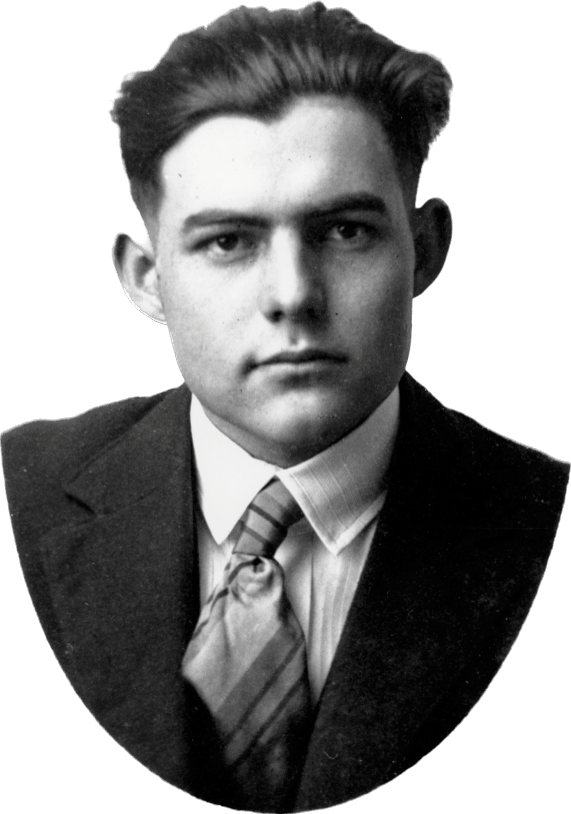
“A strange and wonderful place” is how Ernest Hemingway once described Kansas City, according to a 1999 article by Steve Paul in the Kansas City Star, the newspaper that drew the young Hemingway to the city in 1917.
Ernest Hemingway was only 18 years old when he stepped off the train in Kansas City’s Union Station on October 15th, 1917. On a visit to Hemingway’s parents in Chicago a few months earlier, his Uncle Tyler had told them he could get the young Hemingway a job on the Kansas City Star and that Ernest could live with him at his house on Warwick Boulevard until he was well and truly started. The alternatives to working for a newspaper were either going to college, which didn’t seem all that necessary to Hemingway, or going off to join the war effort in Europe – America had declared war against Germany only 6 months earlier. But Dr Clarence Hemingway, Ernest’s father, had discouraged him from pursuing that idea, insisting he was too young. A job at the highly regarded Star seemed like the best option. It would not only give Hemingway some much-needed independence and freedom from life with his parents, which was very strained at times, but it would also give him some valuable experience of writing professionally. And thanks to the Kansas City Star’s in-house style guidelines, and the editors he worked with, working at the newspaper was to help shape Hemingway’s own, ultimately very influential, literary style.
Relatively little has been written about Hemingway’s time in Kansas City, the notable exception being Steve Paul’s superb and meticulously researched 2017 book, Hemingway at Eighteen. Hemingway himself wrote very little about the city even though he liked the place. His letters to his family during 1917-1918 told of his excitement at being a real reporter on a real newspaper, the Kansas City Star. But the city didn’t make it into much of his fiction – it’s mentioned in only three of his short stories, Soldier’s Home, A Pursuit Race, and God Rest You Merry, Gentlemen. It also gets a few mentions in the novel The Sun Also Rises and in the memoir A Moveable Feast. And the city’s luxurious Muehlebach Hotel, which Hemingway spent some time in, is mentioned by the Colonel in the novel Across the River and into the Trees. But it’s not much, really – you have to search for the references.
Despite this, there’s no doubt that his time in Kansas City helped make Hemingway the writer he became, largely due to the lessons he learned at the Kansas City Star. And in later years, Hemingway chose Kansas City to be the birthplace of two of his children, Patrick and Gregory (later Gloria). In addition, he wrote parts of two books there, A Farewell to Arms and Death in the Afternoon.
As a visitor from Scotland who recently had the opportunity to visit Kansas City, and who also found it a strange and wonderful place in some ways, I was keen to do two things. The most important was to visit any and all locations with a Hemingway connection. For me, literary tourism isn’t a superficial thing. It’s about experiencing a direct personal connection with my favourite authors by visiting the places that shaped them, that meant something to them, that helped shape the stories that have had such a powerful impact on me. Hemingway is a writer who really lends himself to literary tourism as he visited and lived in so many interesting places – Paris, Cuba, Key West, Spain and Africa being perhaps the best known and most visited by those fascinated by his life.
The other thing I hoped to do was get a sense of what made Kansas City such a strange and wonderful place for Hemingway. Of course, that was always going to be a challenge. After all, Kansas City has inevitably changed enormously since Hemingway first visited in 1917, both in terms of what it’s gained and what it’s lost.
For instance, most of Kansas City’s striking downtown skyline simply didn’t exist when Hemingway was a cub reporter for the Kansas City Star. The 29-story City Hall building, the even taller Power and Light building, the spectacular Kauffman Center for the Performing Arts, and the 217 feet tall Liberty Memorial to those who fell in World War I – all of these impressive structures were built years later. However, Hemingway might well have seen a few of these buildings when he returned to Kansas City in later years with his second wife, Pauline Pfeiffer. I’ve included photos of all these buildings at the end of this post, mostly to give an impression of Kansas City today.
Two of the buildings associated with Hemingway are now lost forever, sadly. One is his Uncle Tyler’s house on Warwick Boulevard, due to a fire in 2008. Hemingway only stayed very briefly at this house but as his uncle was the one responsible for him coming to Kansas City in the first place I was sorry I would never have the chance to see it. The second building is Kansas City’s General Hospital – which Hemingway claimed to have been barred from after he spent months investigating it for the Star. It was demolished in 1991-1992, so I was unable to see that either.
But there’s much in present-day Kansas City that the young Hemingway would still recognise.
For instance, the beautiful Union Station, the station he arrived at on a train from Chicago in October 1917, is still around. It’s now far more than a train station but it would have looked much the same in Hemingway’s time as it does now.
The old Kansas City Star building still exists too, although it’s no longer home to the newspaper that drew Hemingway to Kansas City in the first place. But the building itself still stands on Grand Boulevard and, from the outside at least, still looks very much as it would have done on the first day Hemingway walked through its doors to start his job as a cub reporter for the newspaper.
And the building – now called ‘The Hemingway Building’ – that once housed Police Station No. 4 – can still be found only a short distance from the old Kansas City Star building, looking much as it did when Hemingway filed crime stories from it.
Of course, these are only the physical details. The character of the city has also both changed and, in some respects, remained the same. When Hemingway lived there between October 1917 and April 1918, Kansas City was a violent place in the heartland of a country that had just been plunged into a World War. Even though it was a prosperous city of around 300 thousand people, it was one that had its share of problems with drugs, poverty, corruption, and violence, and one that was experiencing outbreaks of smallpox and meningitis while Hemingway was there.
Initially, I must admit I was a little apprehensive about venturing into downtown Kansas City on my own as the reality is that the city has a homicide rate twenty times that of the city I come from. It was a violent place in Hemingway’s time and it’s sometimes a violent place today – one only needs to read the latest editions of the Kansas City Star, which is still going, to see that. There are certainly parts of the city I simply wouldn’t venture into again, and probably shouldn’t have gone into in the first place. However, most of the places listed in this post seemed safe enough to me, especially those near Main Street such as Union Station, those in Warwick Boulevard and those in Mission Hills, Kansas. I’ve found downtown Kansas City surprisingly quiet and peaceful when I’ve been there, and I’ve been deeply impressed by the often beautiful architecture of the city.
I must admit that the first few times I visited any of the locations mentioned in this post I was so preoccupied with finding them and taking photos that I didn’t pause just to reflect on the reality that one of my favourite writers had actually walked these streets more than a century ago, had truly begun his professional writing career here, had years later stayed in these apartments in the Plaza with his wife, Pauline, while they waited for the birth of their first child, and so on. But finally I’d visited this handful of locations often enough that I stopped taking photos and let my mind wander back to the time when the young Ernest Hemingway stepped off the train in the city’s beautiful Union Station to begin his first adult job as a newspaper reporter for the Kansas City Star. I was finally present, but present in the Kansas City of 1917-1918.
Undoubtedly the most significant building in Kansas City associated with Hemingway is the old Kansas City Star building, located at 1729 Grand Boulevard in downtown Kansas City.
Let’s go there.
 The Literary Tourist