
When I discovered that Robert Heinlein, author of Stranger in a Strange Land, The Moon is a Harsh Mistress and Starship Troopers, was born only 60 miles away, I had to go.
As I was pretty much a stranger in a strange land myself, a visitor to America from Scotland, and one that didn’t drive, I was grateful that my lovely Gwyneth would drive us there. It was only about an hour from Overland Park in Kansas and we set out on a beautifully sunny December morning in 2021.
Heinlein was one of those writers I read in my youth and one who I still have a soft spot for, even though I have serious reservations about his later work. But his juveniles, his young adult novels, which I read when I was a teenager – I loved those and still love them. Some of his later stuff is glorious but some of it is painful to read, presumably because he became too commercially successful to be edited or to have stuff rejected. But those early novels, when he did have an editor and wasn’t too famous, when he was writing for a younger audience, those were marvellous and full of the excitement of space exploration. His juveniles were intelligent, well written and utterly thrilling to those who read them at the time. For the longest time, he was the biggest name in the field. It’s said that he felt his greatest achievement was encouraging generations of young people to get involved in science and technology. I’m rather sad that I never got to see him in person at any of the science fiction conventions at which he was Guest of Honour. I would love to have seen him at MidAmeriCon, the world science fiction convention in Kansas City in 1976 but that was long before I ever set foot in America.
It took us only about an hour to get to Butler.
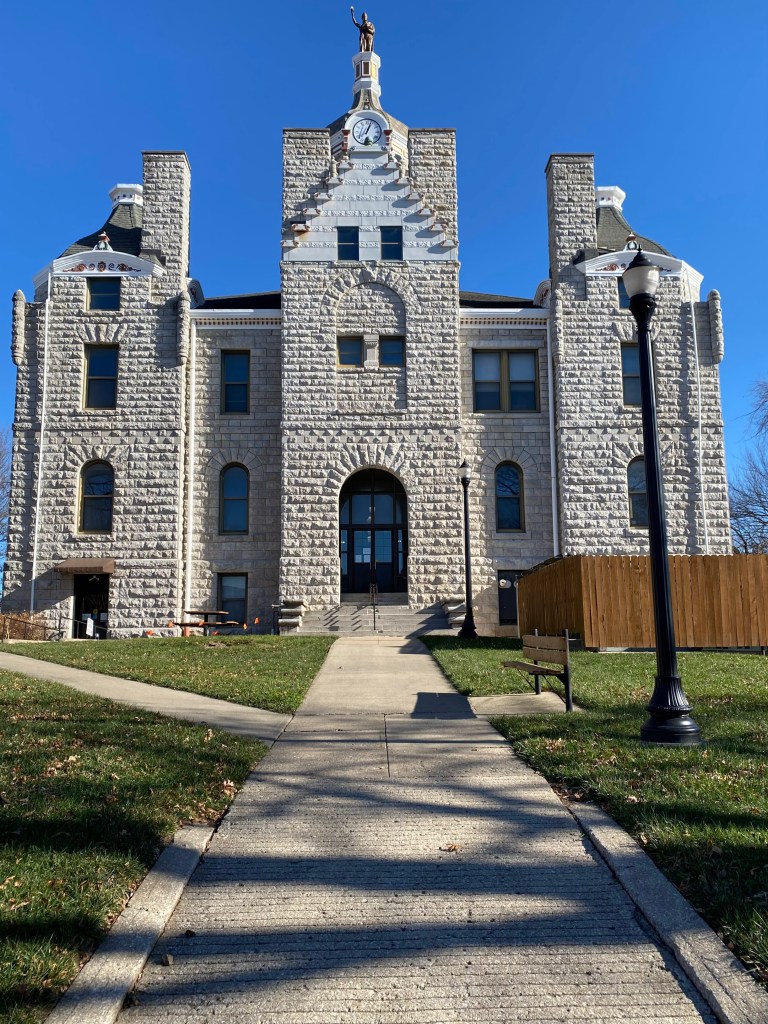
Like most of the small towns I’ve been to in America, Butler seemed surprisingly quiet. The town square was utterly deserted, aside from Gwyneth and I, who went to look at the County Courthouse. Almost everywhere I’ve ever been in Scotland has more people in the streets than I’ve seen in these small towns. I’m still not entirely sure why.
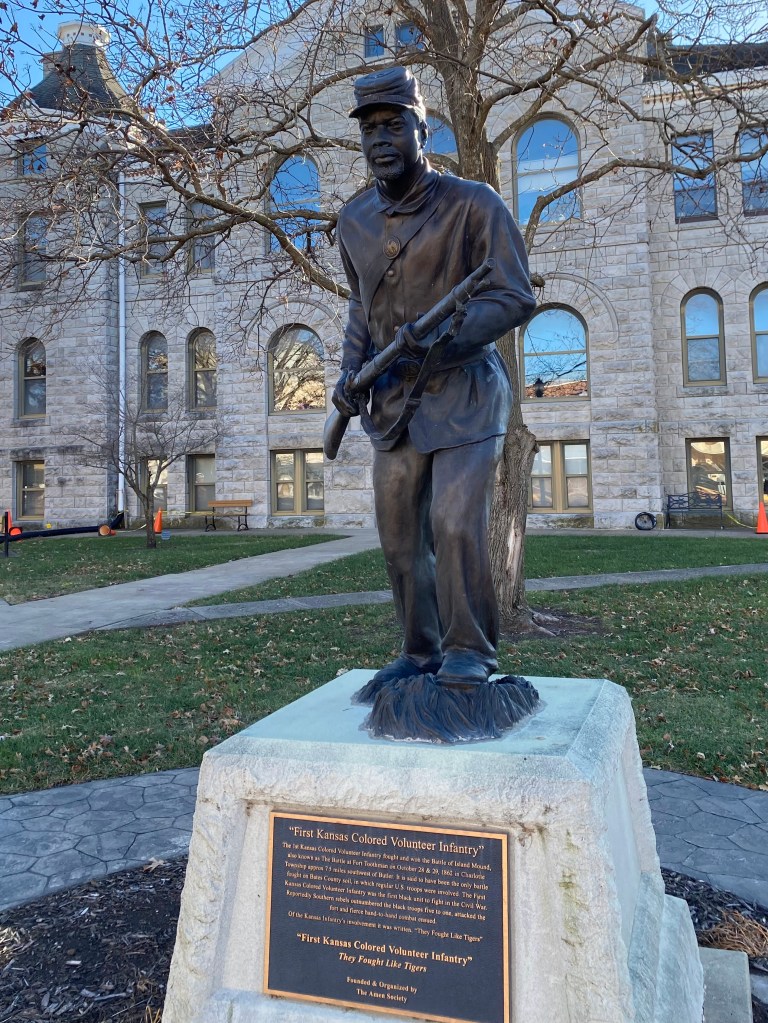
The Bates County Courthouse was quite impressive, as many of these courthouses are, and brought to mind some courtroom scenes from Heinlein’s novels. Outside the Courthouse was a statue honouring the “First Kansas Colored Volunteer Infantry”, the first black unit to fight in the Civil War. Of their involvement it was written, ‘They Fought Like Tigers’. Nearby there were two other Memorials to veterans. America shows immense respect for its military.
But going to Bates County Courthouse and the town square was one of the last things we did that day. The first thing we did was go to Butler Public Library, which has a Heinlein room or to give it its full title, ‘The Robert A. & Virginia Heinlein Addition’. After he died in 1988, Robert Heinlein’s wife, Virginia, informed the library of her husband’s wish to expand his hometown library. Funds from the Robert A. and Virginia Heinlein Foundation led to the library being renovated, and to the construction of a new wing, the ‘Heinlein Addition’.
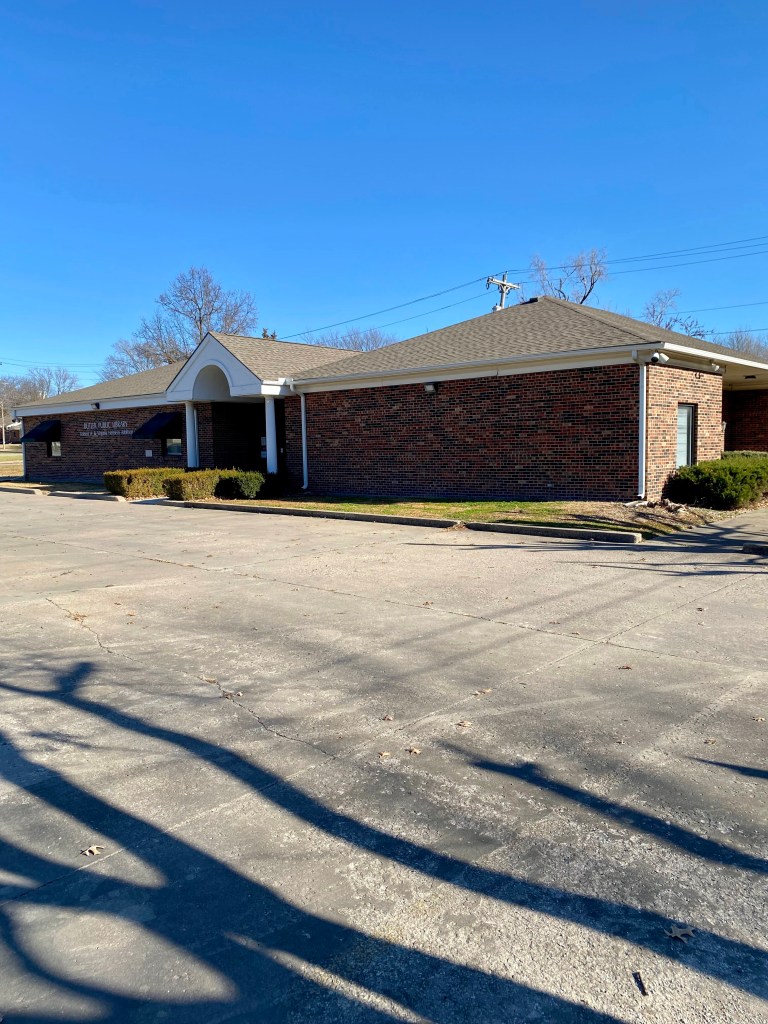
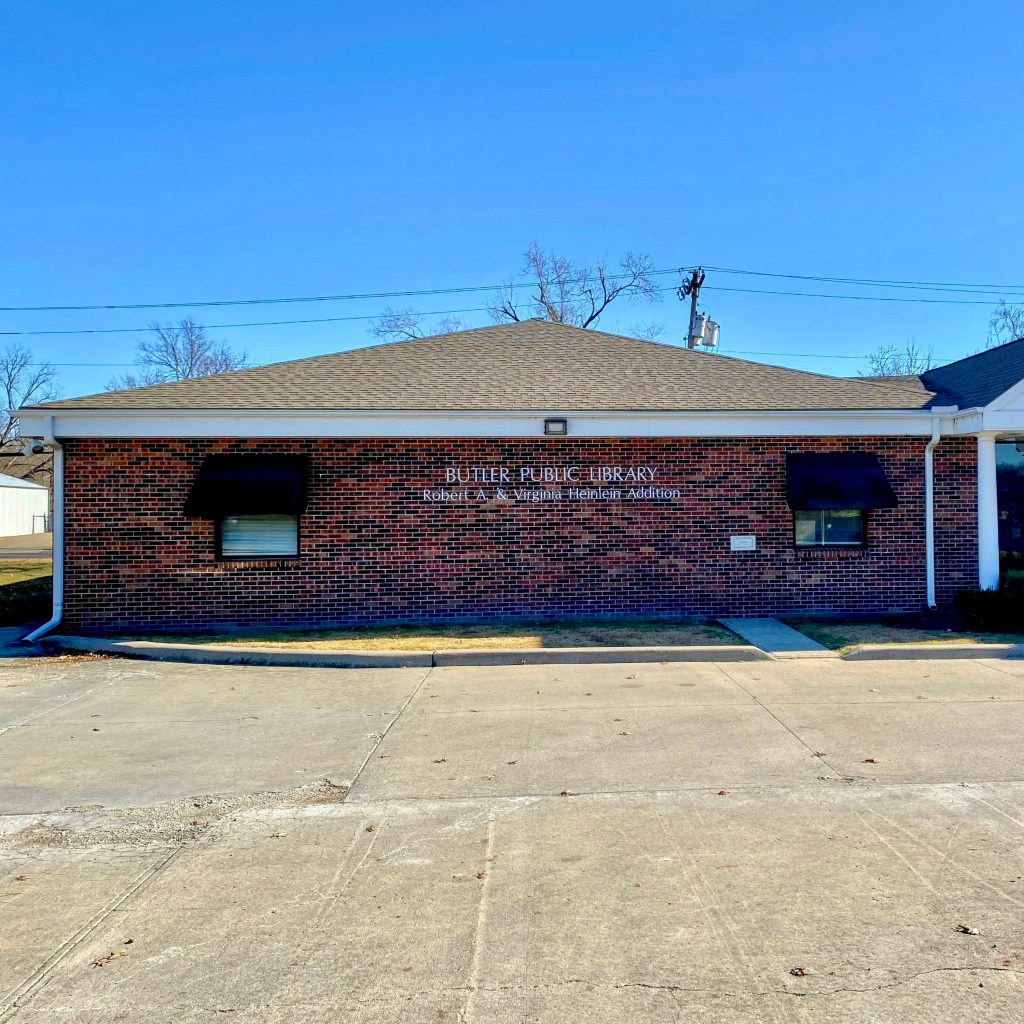
I was keen to see this library and the Heinlein room in particular. After taking some photos of the building, we went inside to a lovely little library. Almost as soon as we asked the librarian at the desk where the Heinlein room was, we spotted it – in truth, it was hard to miss.
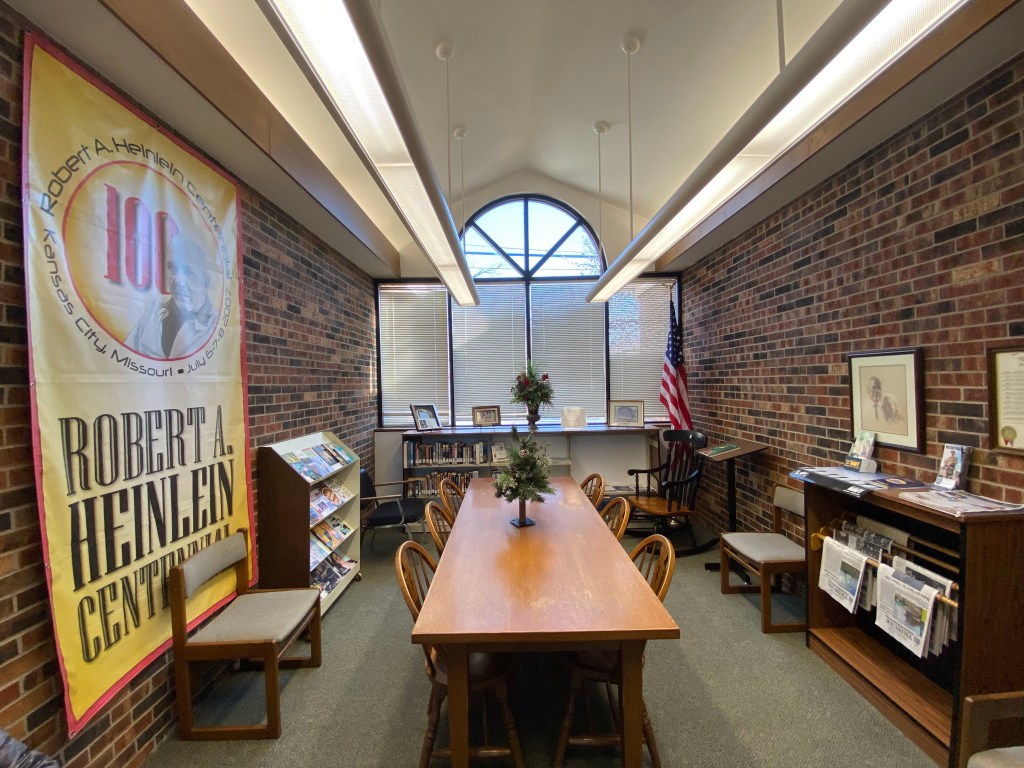
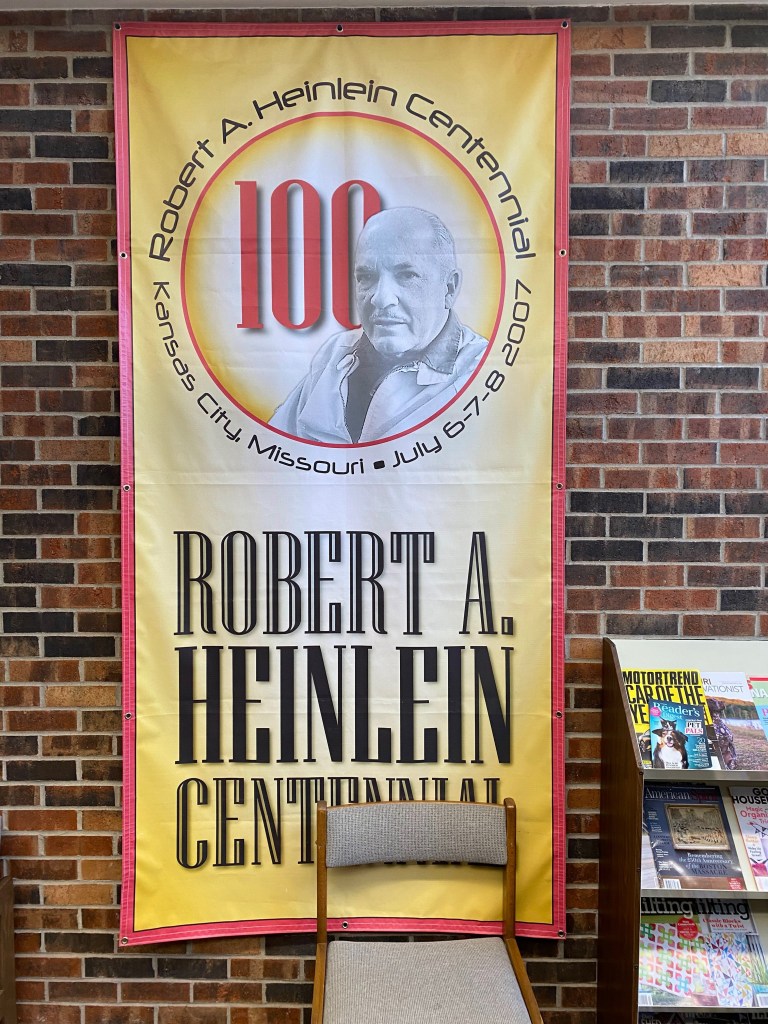
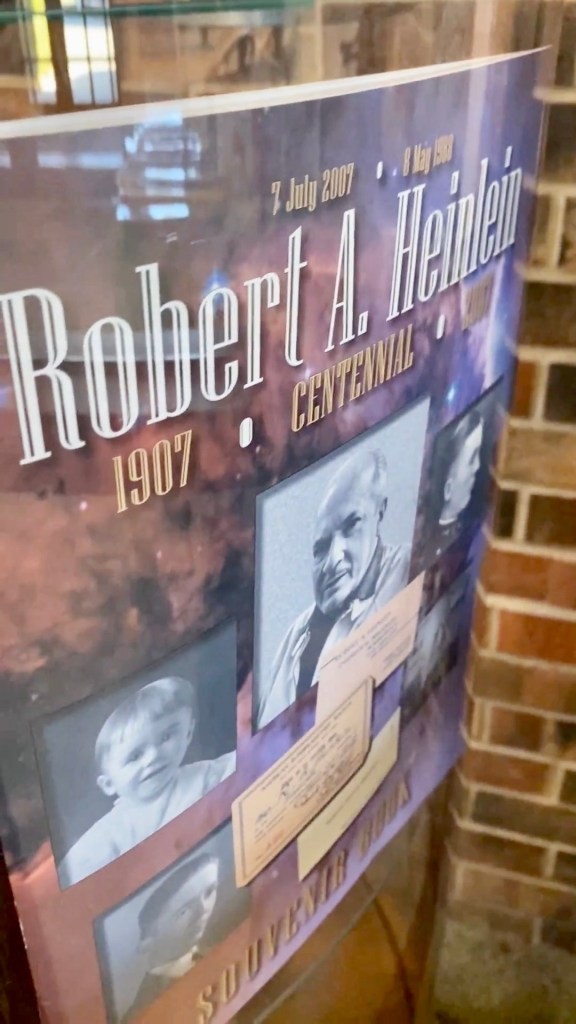
I suppose the first two things we saw when we entered were the large banner with a picture of Heinlein on the wall to our left, marking the Centennial of his birth. The Heinlein Centennial Convention had been held in Kansas City in July 2007. The Guests of Honor had been Robert and Virginia Heinlein, in absentia and deceased. Many notable science fiction authors attended, along with Administrator of NASA, Michael D. Griffin and others involved in the spaceflight industry. Another Heinlein-related event in Kansas City I would love to have attended. The banner was donated as soon as the convention was over and brought to the library by Heinlein fans and at least one of the convention organisers.
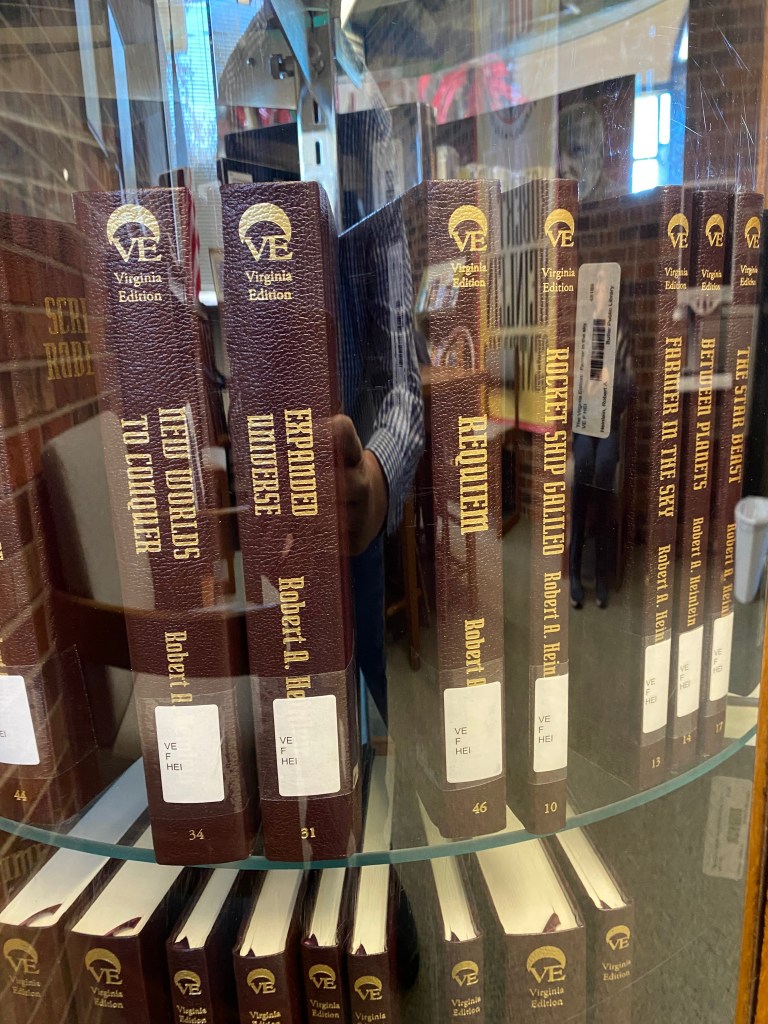
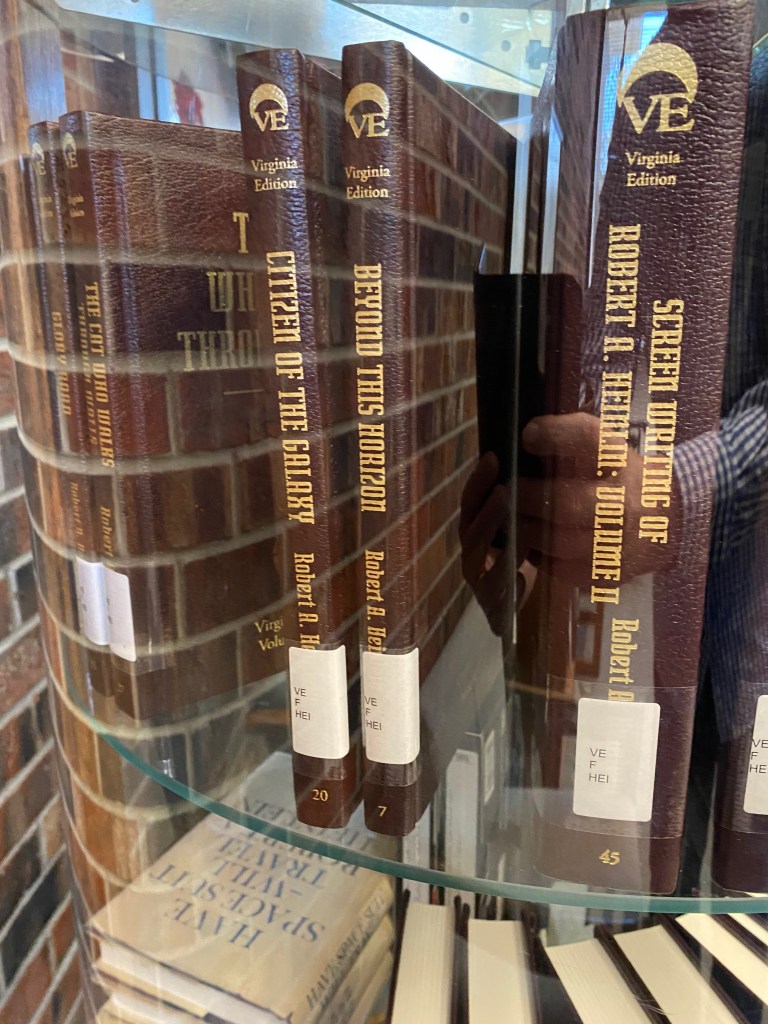
In one corner of the library was a wood and glass cabinet containing a full set of the Virginia Edition of the Complete Works of Robert Heinlein. Only 2000 sets were produced. Each of the 46 volumes is bound in leather and looks beautiful. Virginia Heinlein herself oversaw their publication and they contain all of Heinlein’s published fiction and nonfiction, along with 450,000 words of correspondence, most never published before. At $1500 a set, it’s unlikely I’ll ever own one. The case the books were displayed in appeared to be locked and I regret that I didn’t simply ask the librarian if it was possible to handle them and browse through them. It simply didn’t occur to me, I thought they were for display only, and perhaps they are. But if Gwyneth and I ever go back, I’ll ask. It can’t do any harm. I believe the set was donated to the Library by a couple of Heinlein fans, Deb Houdek Rule and Geo Rule, who are on the Board of the Heinlein Society, a charitable organisation dedicated to Heinlein’s principle of “Pay It Forward.”
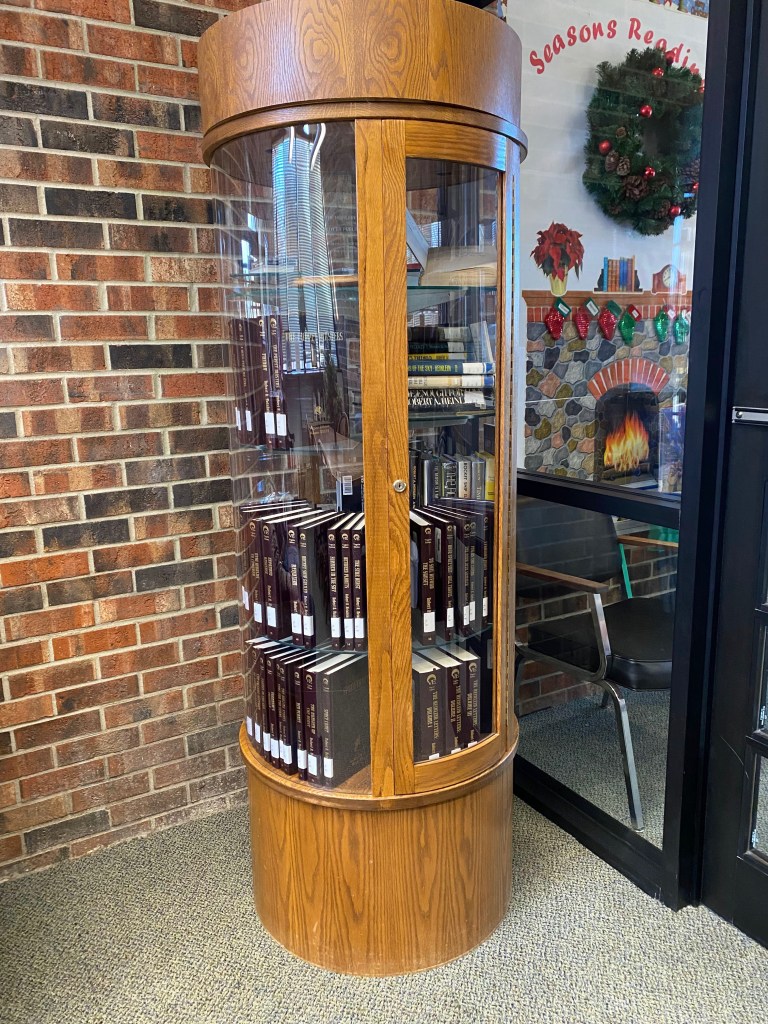
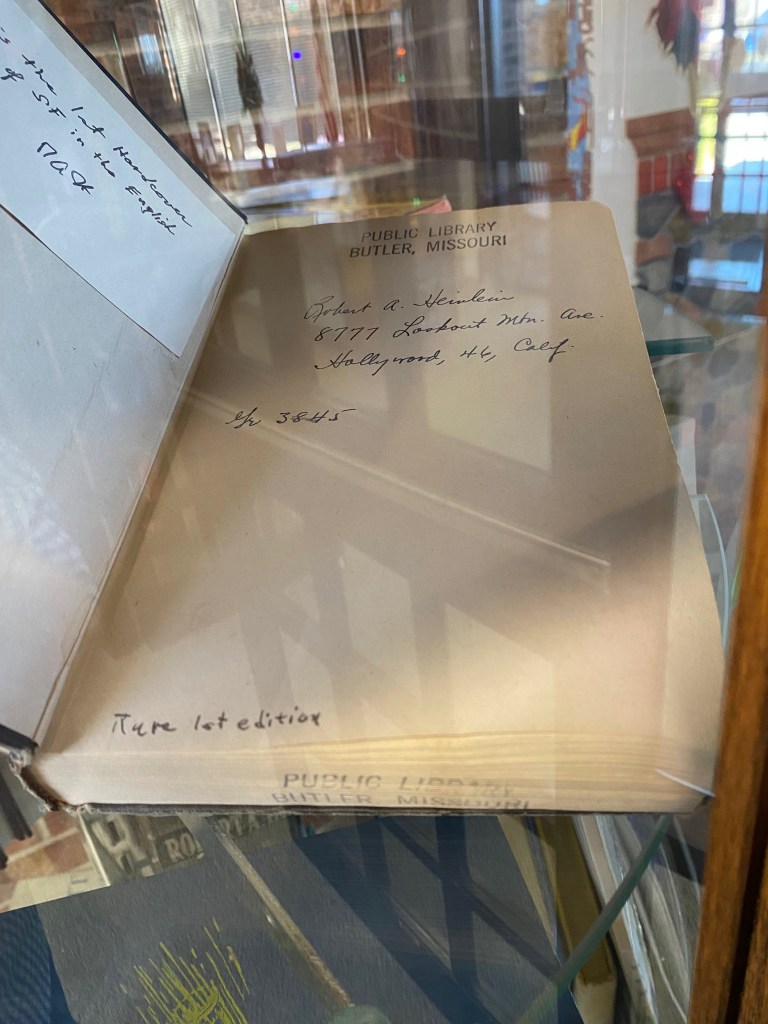
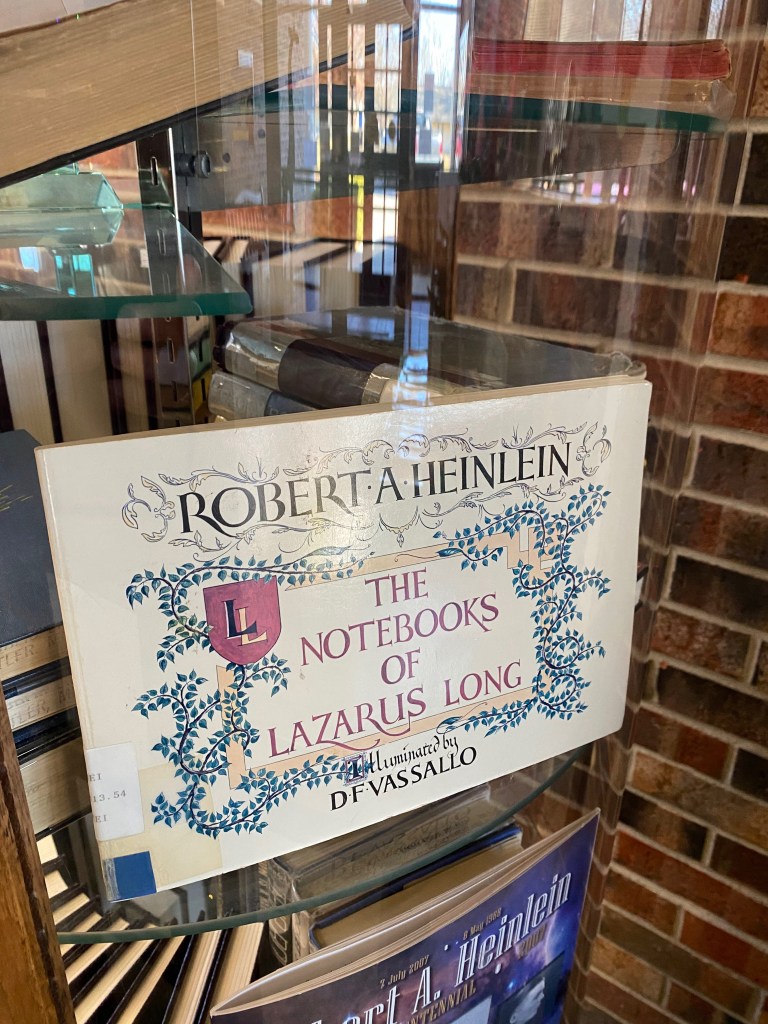
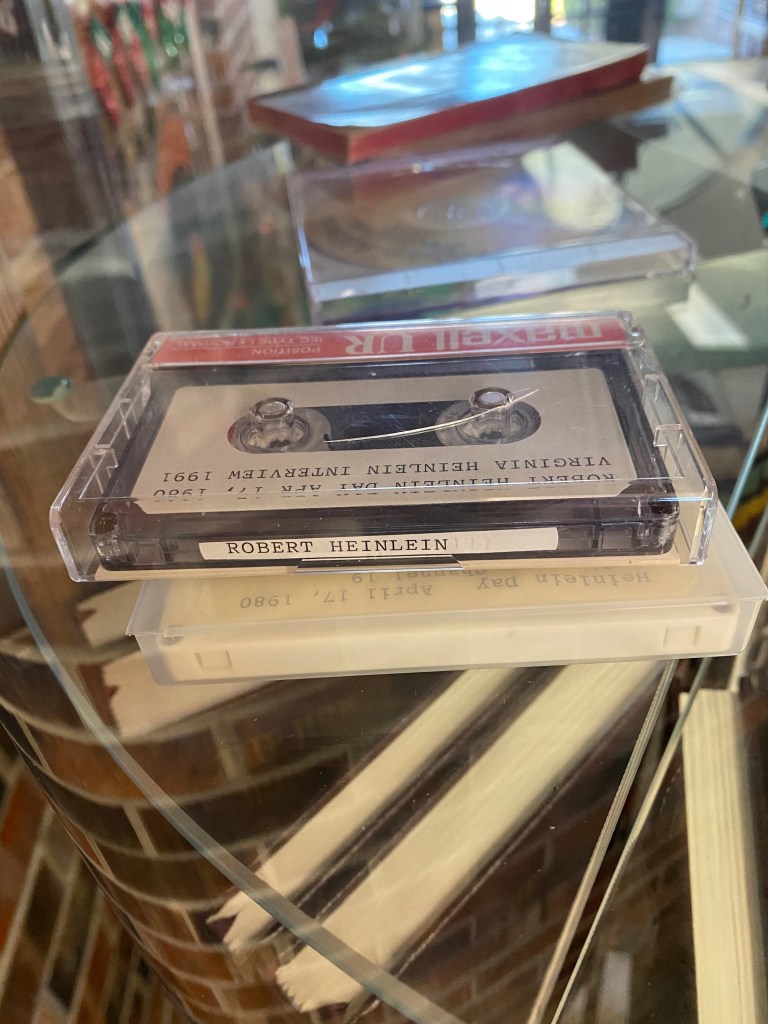
But the Virginia Edition wasn’t all that was in the cabinet. I also saw a signed first edition of Heinlein’s short stories, a copy of the 44 page Robert A. Heinlein Souvenir Book that was published for attendees of the Centennial Convention in Kansas City in 2007, an illustrated edition of the Notebooks of Lazarus Long (one of Heinlein’s most popular characters), an interview with Virginia Heinlein on cassette, and so on. I would love to hear that interview. Virginia Heinlein was married to Robert Heinlein from 1948 until his death 40 years later and would have known him better than anyone else in the world. Virginia, or ‘Ginny’ as she was known, was both a chemist and a rocket engineer and had held a higher rank in the Navy than Heinlein. Many of the female characters in his books are clearly modelled on her.
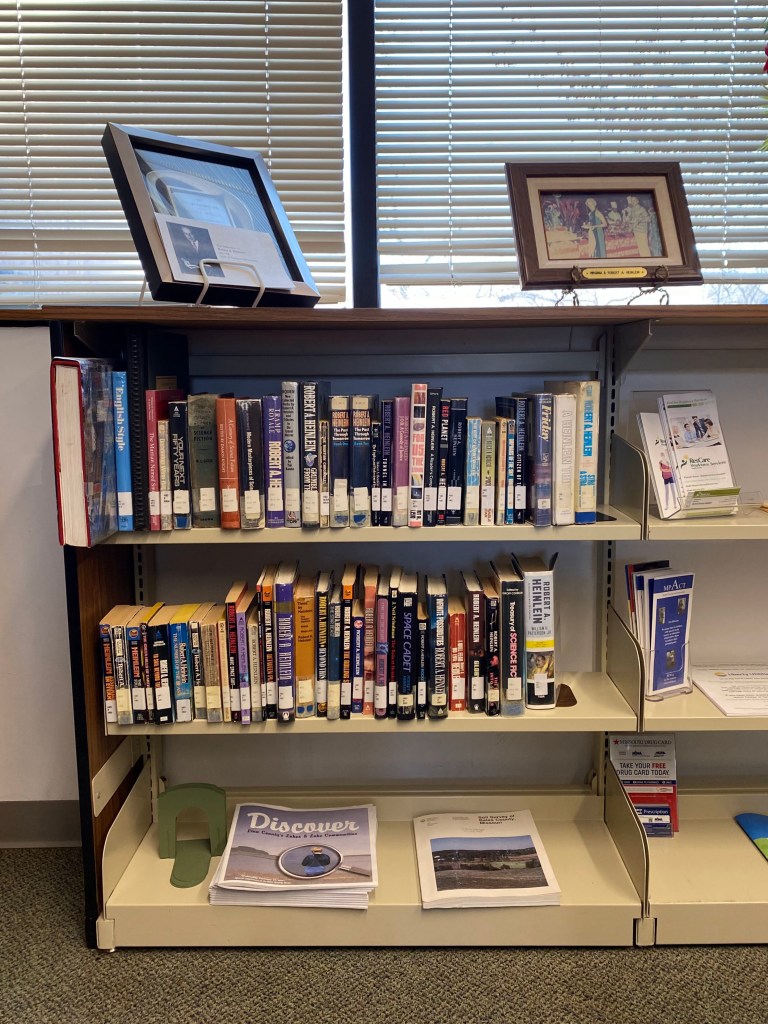
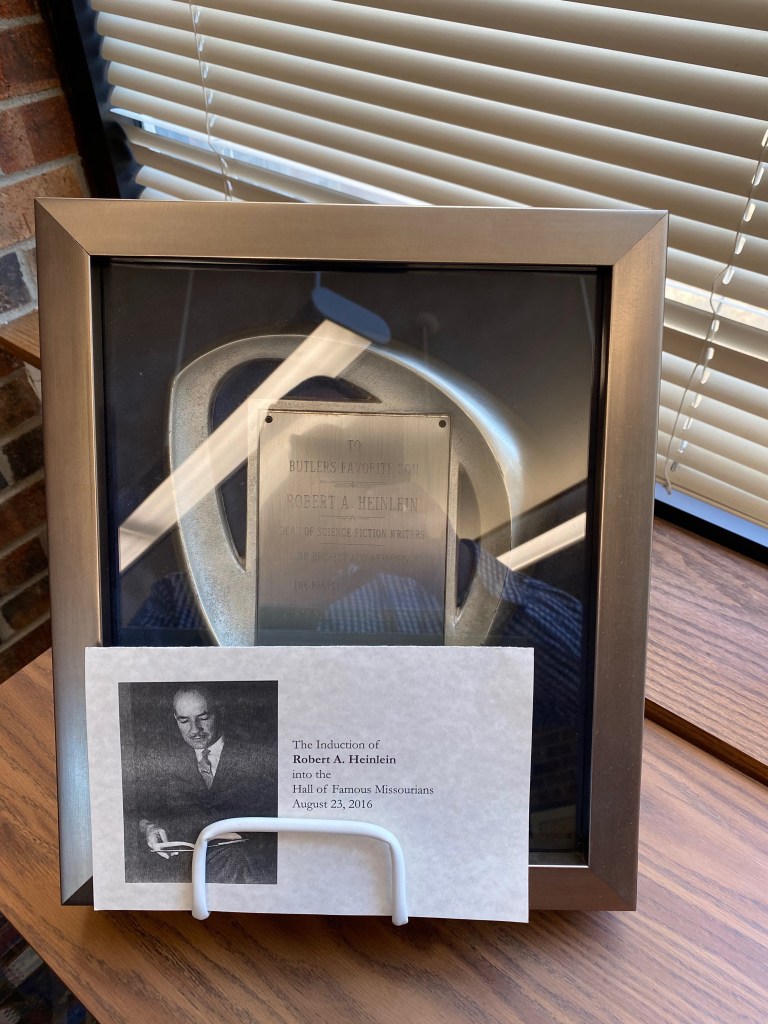
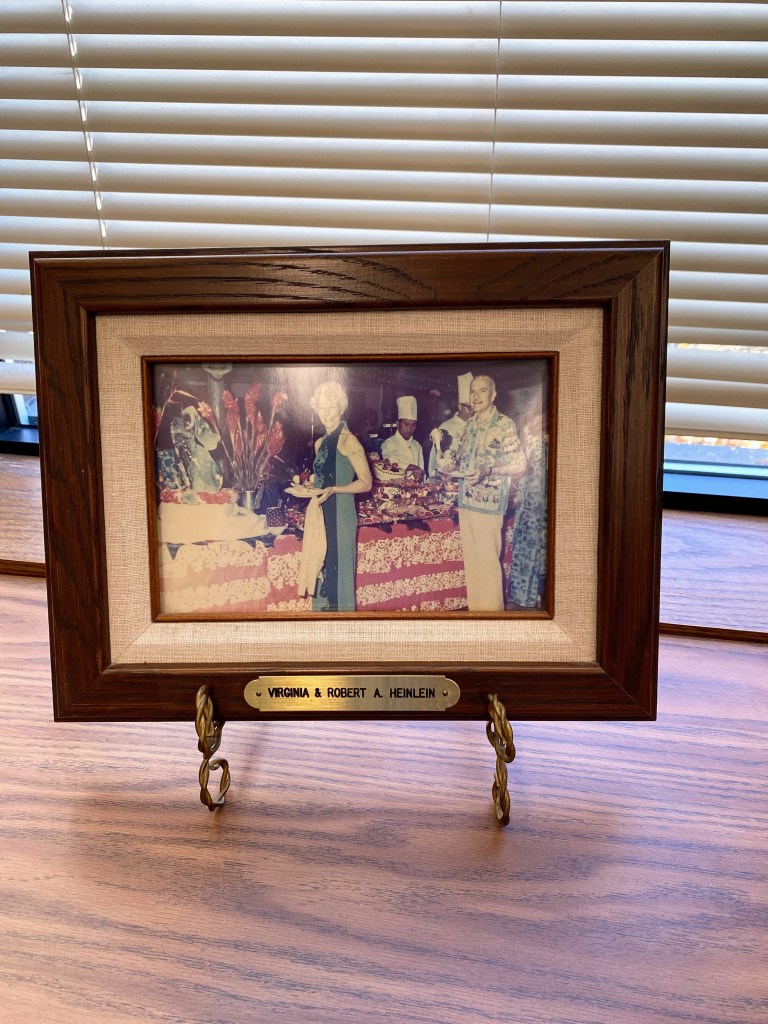
Against the back wall of the room, beneath the window, were two shelves full of books by and about Heinlein, including William H. Patterson’s monumental two-volume biography of him. I’m working my way through that at the moment. It’s clearly been meticulously researched and makes for fascinating reading if you’re a Heinlein enthusiast. On the top shelf was a photograph of Robert and Virginia, apparently taken while they were on a cruise. On the left was a framed metal plaque relating to Heinlein’s induction into the Hall of Famous Missourians on August 23 2016. Inscribed on it were the words:
‘To Butler’s Favorite Son, Robert A. Heinlein, Dean of Science Fiction Writers, With Respect and Affection, From the People of Butler, MO’
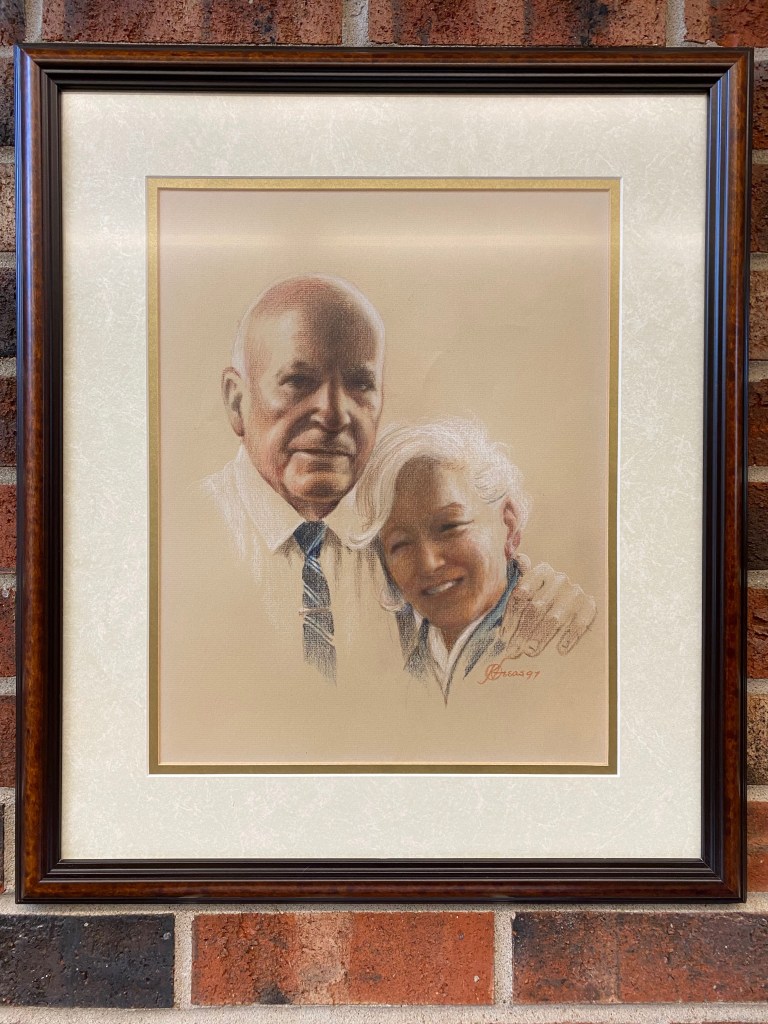
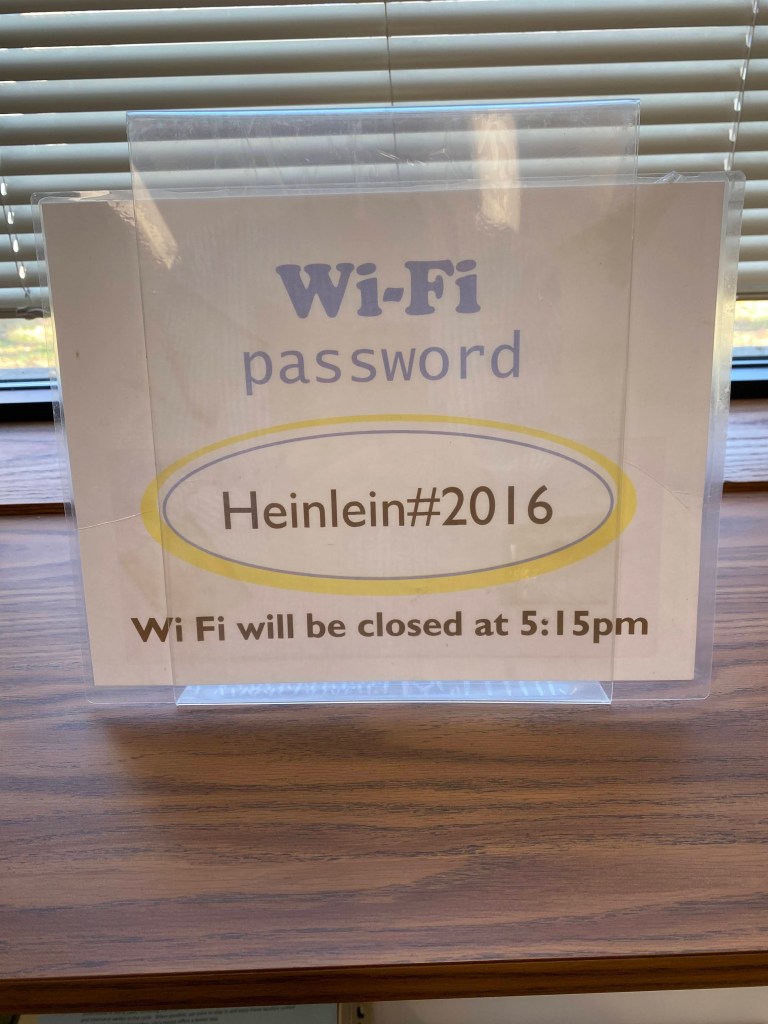
On one of the walls of the room was a wonderful sketch of Robert and Virginia Heinlein by Kelly Freas, a well-known science fiction artist. You can see it at the start of this blog entry. The WiFi password for the library was an amusing touch:
In an online Heinlein group, I had read that anyone could get a library card from Butler Public Library, even if they didn’t live there. The cost was only $5. Of course, I had to get one, even though I never had any intention of borrowing anything from the library, ever. It would just be a nice little memento of my visit to the place. So we went out front and a few minutes later I had a card from the library in Heinlein’s birthplace to take home with me. A little thing, but I was delighted.
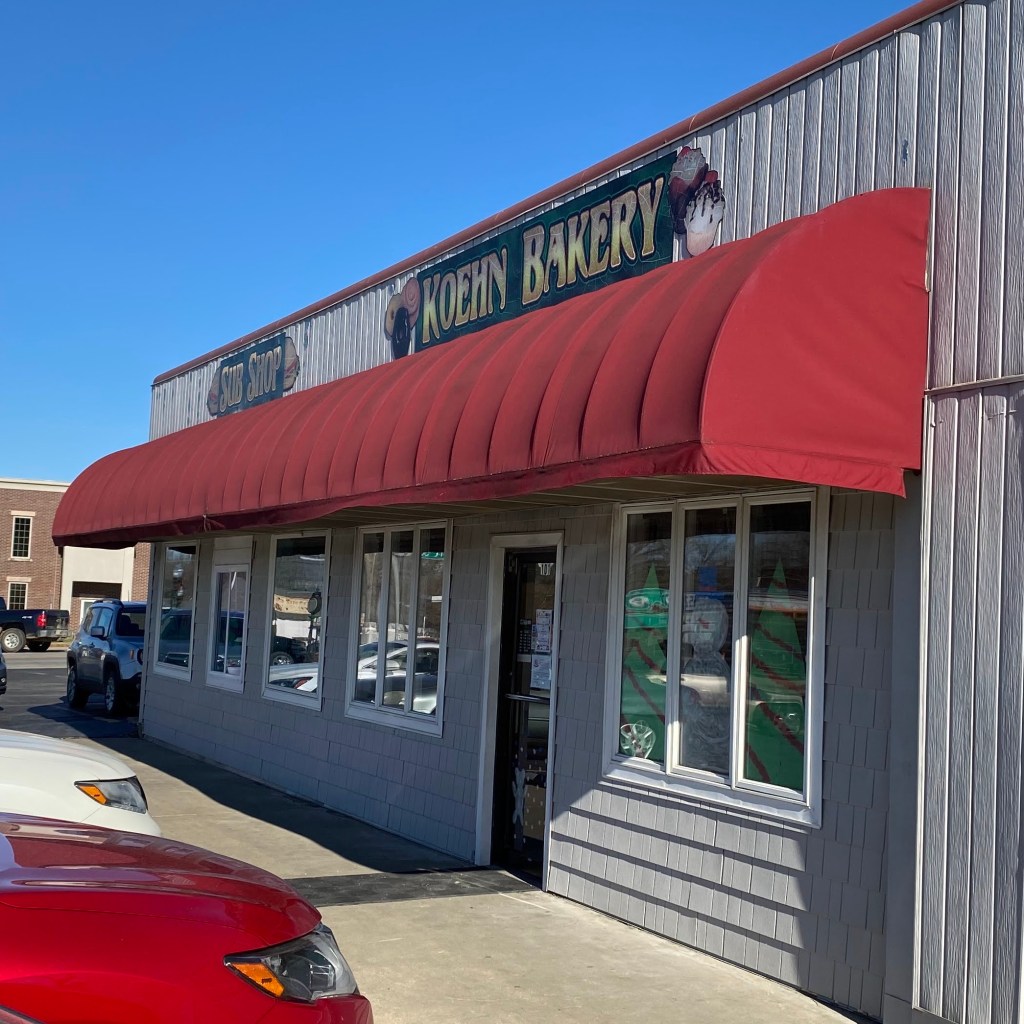
Gwyneth and I decided it was time for something to eat so we went to a nice little family-owned and operated bakery, called Koehn Bakery on Orange Street. Gwyneth and I shared a roast beef sandwich with horseradish sauce – and that’s where we went wrong. Not the sharing, that was sensible as it was a large sandwich. To understate it, the interior of the Sun is cooler than that horseradish sauce. It was far and away the hottest we’d ever tasted, and brought tears to our eyes. We couldn’t help laughing. I’m sure the sandwich would have been fine if we hadn’t opted for the sauce. And the truth is it was a lovely little place, and as we left we bought some bread from it to take home.
But it was time to find the house where Heinlein had been born. After all, that was the point of the visit.
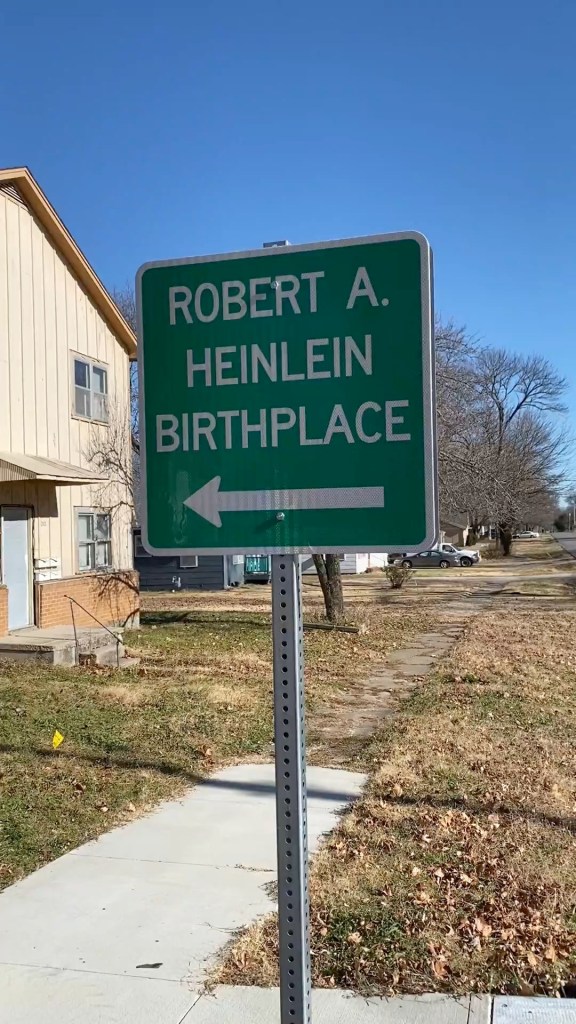
Somewhere online I had found the name of the street where the Heinlein house (as I thought of it) was located. Looking at the street view on Google Maps, I could see a house with a sign outside it saying ‘ROBERT A. HEINLEIN BIRTHPLACE’, with an arrow apparently pointing to the first house in the street. So I knew it would be easy enough to find and indeed it was.
This is that house and sign:
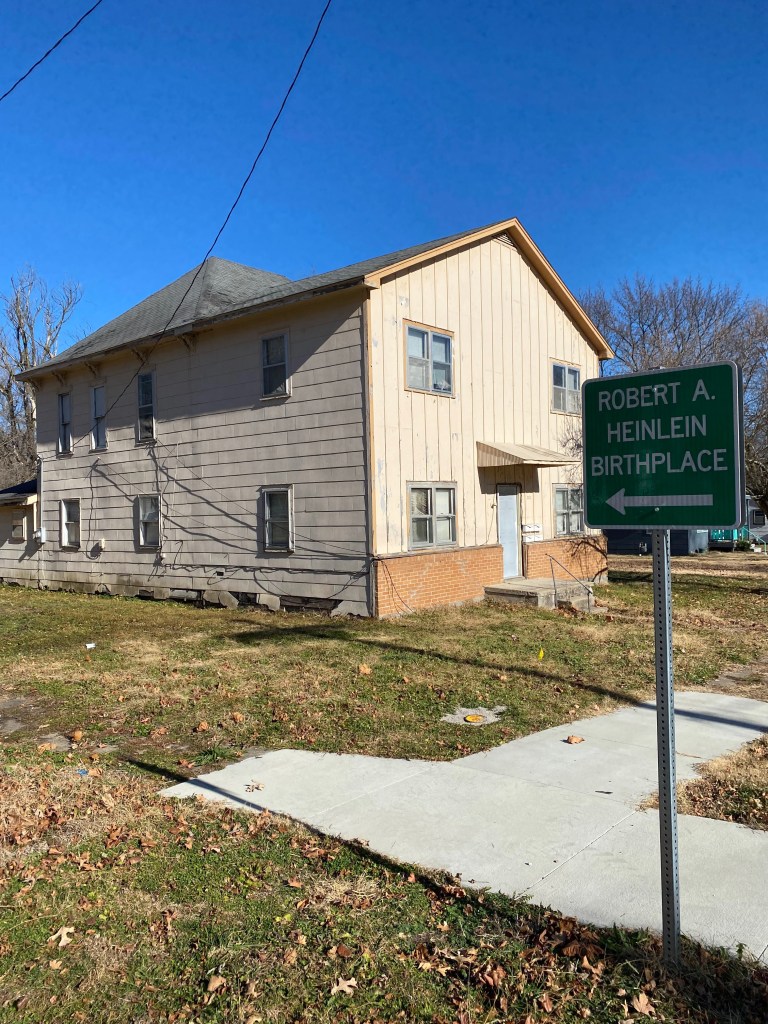
Of course, I was excited to find the house and took many photos of it, noting that it appeared to be unoccupied. Gwyneth questioned whether this was really the birthplace house as the sign appeared to be pointing farther up the street but I was convinced this was it.
Late that night, after we’d returned home, some real doubt crept into my mind. In the morning I did some more research online.
I should have listened to Gwyneth. We’d gone to the wrong house.
 The Literary Tourist