
Cummy’s Grave
Behind many great writers lies an early influence who helps shape their inner world—and for Robert Louis Stevenson, that person was Alison Cunningham, affectionately known as “Cummy.” Born in 1822 in Torryburn, Fife, Cunningham joined the Stevenson household in Edinburgh in 1852 and became the young Louis’s devoted nurse and caregiver during a childhood plagued by illness.
Cummy was a strict Calvinist and brought with her a deeply religious sensibility. She read to Stevenson from the Bible, the Shorter Catechism, and the works of evangelical authors like Robert Murray M’Cheyne. But she was also a natural storyteller, recounting vivid tales of Scottish history, particularly the suffering of the Covenanters—stories rich in drama, moral conflict, and supernatural overtones. Although these stories were often a source of nightmares for the boy, they also seeded in his fertile imagination the themes of good and evil, adventure, and moral ambiguity that would later define classics like The Strange Case of Dr Jekyll and Mr Hyde and Kidnapped.
Stevenson never forgot the woman who stood at his bedside night after night, nursing him through bouts of illness and kindling his love of story and language. He called her his “second mother” and even “first wife,” and he dedicated his wonderful poetry collection A Child’s Garden of Verses (1885) to her. In a letter, he wrote movingly, “You have been for a great deal in my life; you have made much that there is in me, just as surely as if you had conceived me.”
After Stevenson’s death in 1894, Cunningham received a degree of public recognition. Her connection to the famous author brought her modest fame in her later years. In 1926, her reflections on their time together were published in Cummy’s Diary, which included memories of their travels in 1863.
After Stevenson’s death in Samoa in 1894, Cummy lived nearly two more decades. In her final years, though deaf, she was described by friends as mentally sharp, quick-witted, and socially engaged. She loved to reminisce about her years with “Louis” and often revisited the old Stevenson home at Swanston. There, she would point out treasured landmarks: the garden quarry where he wrote, the ivy planted by Mrs. Stevenson, and the site of a long-lost henhouse, fondly recalled by fans of Stevenson’s novel ‘St. Ives’.
Three weeks before her death, Cummy suffered a fall and fractured her thigh. Her strong constitution gave hope, but she ultimately didn’t recover from the shock. Her passing marked the end of an era—but not of her influence. As Lord Guthrie wrote in a tribute, she not only tended to Stevenson’s physical ailments but also helped instill the deep moral and religious convictions that remained with him through all his literary adventures.
Though her role was domestic and often quiet, Cummy’s impact was anything but small. She helped raise a child whose imagination would carry readers to treasure islands, haunted streets, and enchanted gardens …
The grave of Alison Cunningham in Morningside cemetery in Edinburgh.
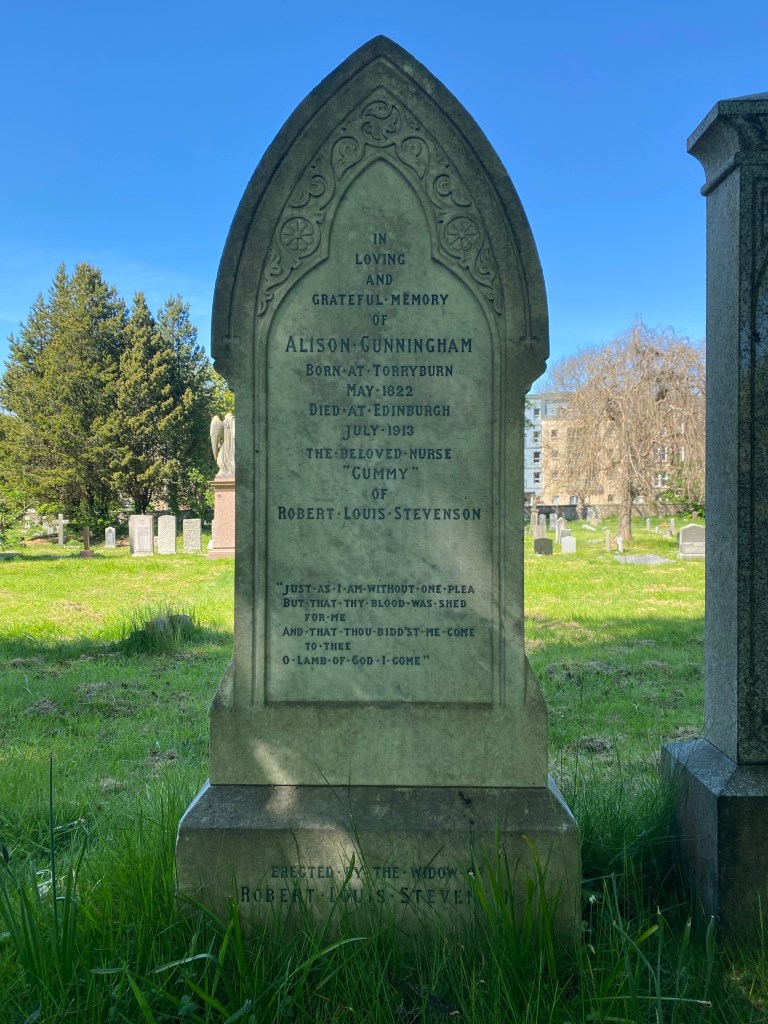
IN
LOVING
AND
GRATEFUL • MEMORY
OF
ALISON • CUNNINGHAM
BORN • AT • TORRYBURN
MAY • 1822
DIED •AT • EDINBURGH
JULY・1913
THE • BELOVED • NURSE
“CUMMY”
OF
ROBERT • LOUIS • STEVENSON
“JUST • AS • I • AM • WITHOUT • ONE • PLEA • BUT • THAT • THY • BLOOD • WAS • SHED
FOR • ME
AND • THAT • THOU BIDD’ST • ME • COME
TO • THEE
0 • LAMB • OF • GOD • I • COME “
At the bottom of the gravestone are the words:
ERECTED • BY • THE • WIDOW • OF
ROBERT • LOUIS • STEVENSON

 The Literary Tourist
CONGRATULATIONS: A wonderfully crafted narrative accopanied by high calibre sensitive photography.
LikeLiked by 1 person
Thank you, Rex!
LikeLike