
This is an AI generated podcast based on the contents of this blog. It gives a quick and hopefully entertaining summary of the various places I’ve written about so far. The podcast was created using NotebookLM. The presenters you’ll hear aren’t real people, they’re AI voices, although pretty convincing ones in my opinion. The podcast is meant simply as a piece of entertainment and as an enticement to read the blog posts themselves, which are far more detailed. I hope you’ll enjoy listening to it.
Tag: Edinburgh
Visiting the Stevenson House in Edinburgh, Scotland
The home of Robert Louis Stevenson from 1857-1880
Note: this is a standalone excerpt from my longer post ‘Robert Louis Stevenson in Edinburgh’.
October 13th 2023
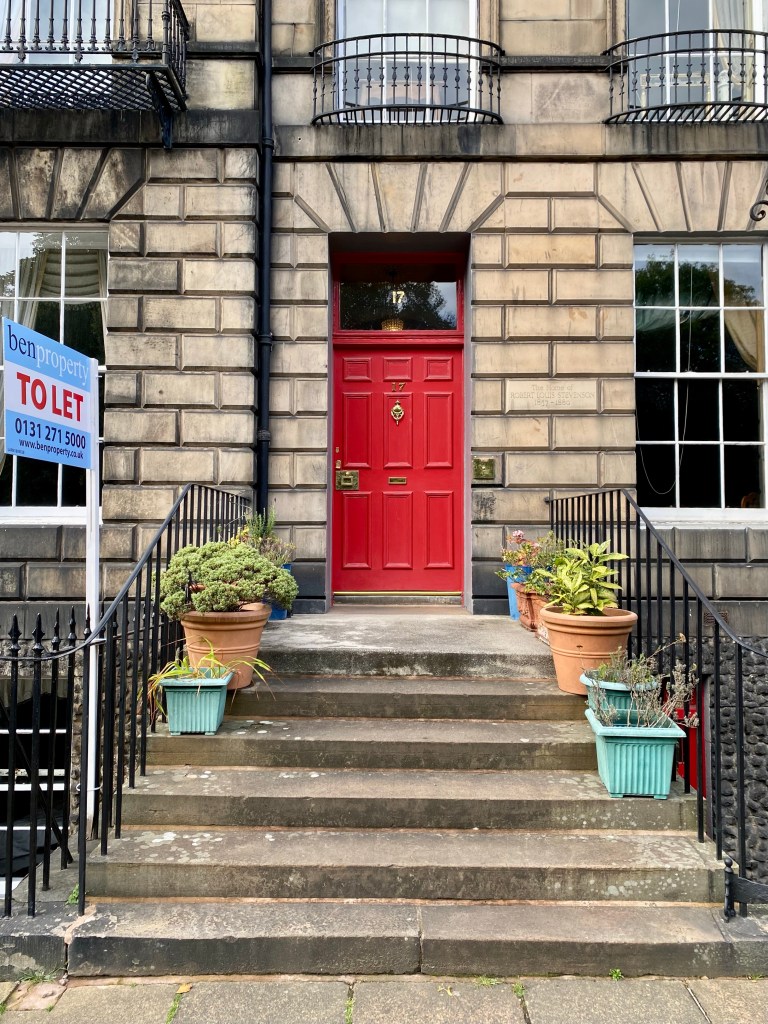
Well, today a little dream of mine came true. As a lover of Robert Louis Stevenson’s work, I’ve always wanted to see inside the house at 17 Heriot Row in Edinburgh where Stevenson grew up. And today, thanks to the kindness and hospitality of the current owner, John Macfie, I was finally able to realise that little dream.
Robert Louis Stevenson, of course, was the author of Treasure Island, Kidnapped, and The Strange Case of Dr Jekyll and Mr Hyde. He was born in Edinburgh on 13th November 1850. Ever since I picked up a copy of Treasure Island as a boy, he’s been one of my favourite authors.
A couple of weeks ago, when I was visiting the Writers Museum in Edinburgh, I got chatting to one of the volunteers in the museum and mentioned that I’d love to visit Stevenson’s former home on Heriot Row. The volunteer said that he believed the owner was quite amenable to visitors, and so that evening when I got home I emailed John Macfie. I told him about the conversation at the Writers Museum, that I was an admirer of Stevenson, and simply asked if it would be possible to visit the house.
I got a lovely, friendly email back from him saying he was always delighted to meet those interested in RLS, and asking me to phone to arrange a date and time for a visit. That date and time was today at 1 pm.
I had also asked if I could bring along my friend, Fiona, who was also keen to see the place. John was fine with that. Fiona is a friend of many years, who knows Edinburgh well and who is a voracious reader, although her tastes incline more towards mysteries. Nonetheless, she has read some of Stevenson’s work and I had previously shown her all of the places in Edinburgh where he had lived.
So at 1 o’clock exactly, Fiona and I turned up at the front door of 17 Heriot Row, the house where Robert Louis Stevenson had lived from the age of six until he was a grown man.
I pressed the buzzer and moments later John Macfie opened the door, greeted us warmly and invited us in. So on a bright, windy, autumnal afternoon, I got to step inside the Stevenson House and see for myself the beautiful interior of the home where RLS had once lived. Indeed, he lived longer in this house than in any other throughout his life.
John led us upstairs to a beautiful room on the first floor and invited us to sit down on comfortable little armchairs. He couldn’t have been a more gracious and interesting host, and in that lovely room he talked to us about Robert Louis Stevenson and the house we were in for the next hour and a half. John’s an engaging and immensely knowledgeable speaker on the subject of Stevenson and it was fascinating listening to him.
As I mentioned in my longer post on him, Robert Louis Stevenson was called ‘Lewis’ or ‘Louis’ by all who knew him, and this was how John referred to him throughout our meeting. I liked that, it seemed particularly appropriate in the house where RLS had grown up. John also pronounced ‘Jekyll and Hyde’ as ‘Jee-kill and Hyde’, just as RLS himself pronounced it. Little details but an indication of how well John knows his subject.
The house itself is a gorgeous place, decorated (to my untrained eyes) in period style, full of books and pictures, with lots of nods to its famous former resident. Unlike many childhood homes of famous people, it’s not a museum, but a fully lived-in, well-loved house. It’s a house that previously belonged to John’s mother, but it’s now the family home for John and his wife, Felicitas, and their family. Felicitas trained as a hotel manager in Switzerland and saw the potential to use the house as a venue for hosting dinners, receptions and conferences. In addition, two of the bedrooms in the house are available on a bed-and-breakfast basis. Edinburgh has many great places where you can stay for a few nights – or for a few weeks – but I can’t imagine anywhere better than the Stevenson House. I might be slightly biased, of course, as it was the home of one of my favourite writers …
This is the beautiful room in which the three of us sat, lost in conversation about the house’s most famous resident:
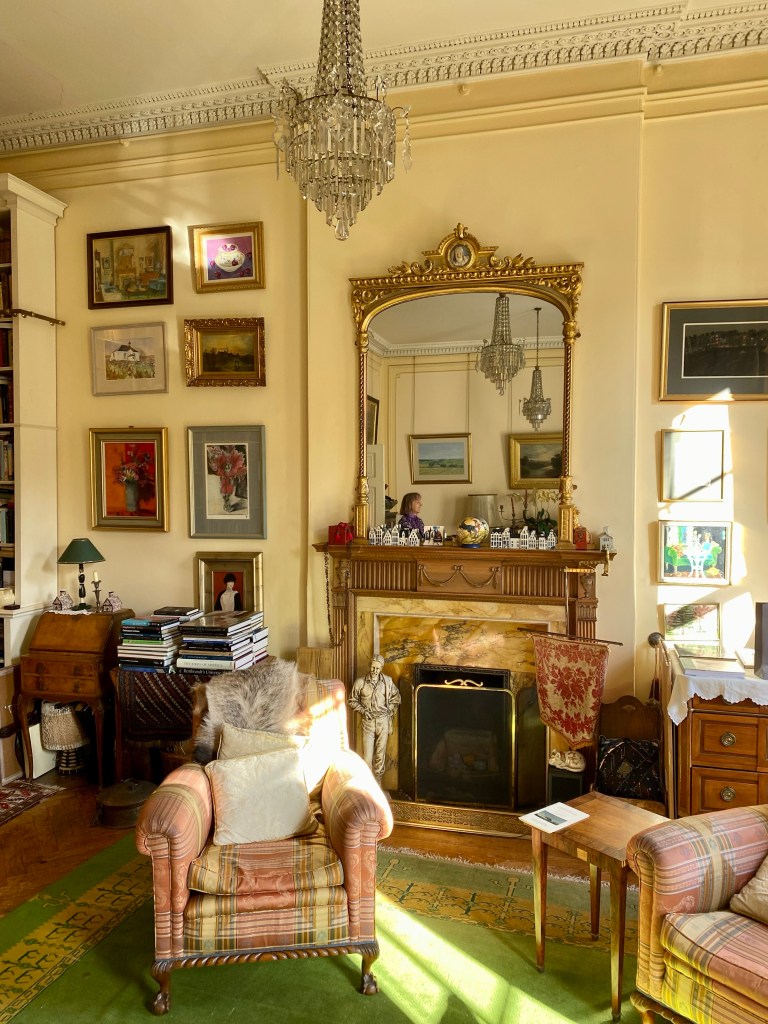
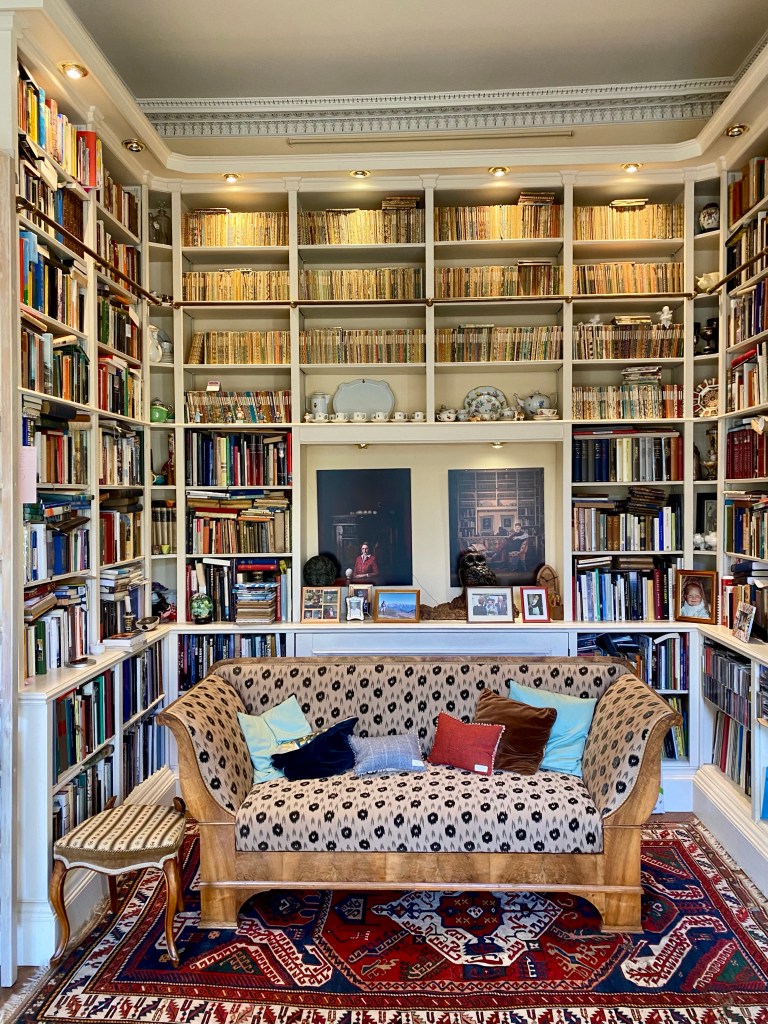
At one point, John went over to this lovely library and read to us from one of the books in it, and showed a little book about one of the lighthouses built by the Stevensons.
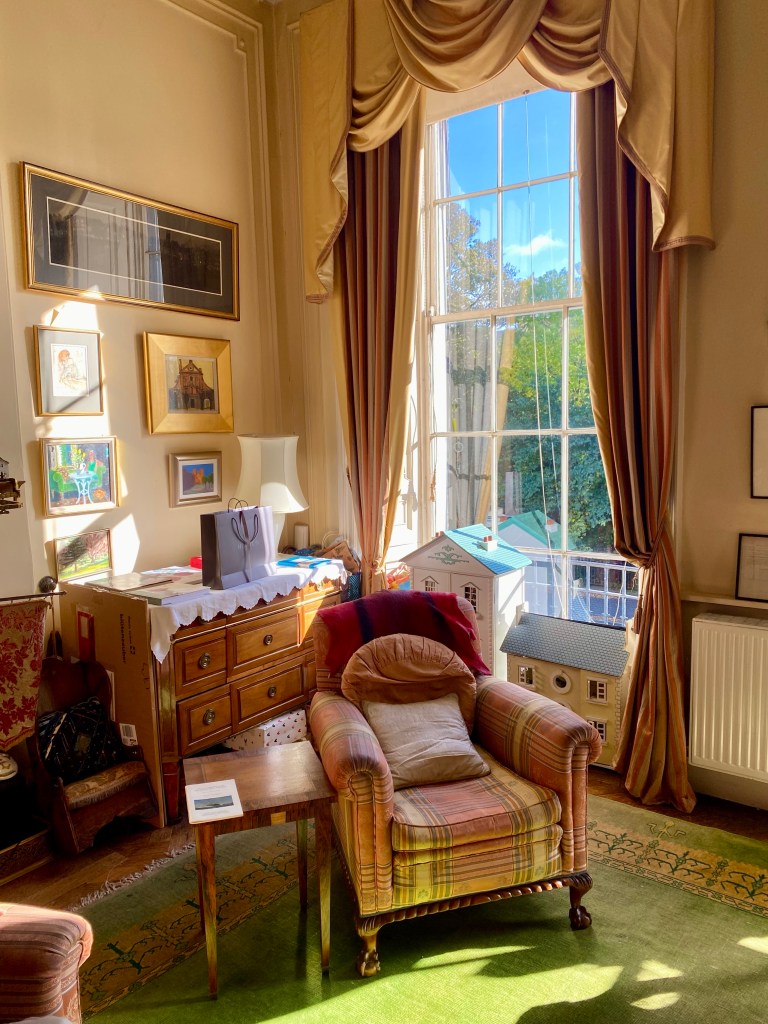
This is the chair on which I sat, and the little booklet on the table is the one John showed us – if I remember correctly, it was about the Bell Rock Lighthouse. As you can see through the window, it was a beautiful day outside, with the sunshine nicely illuminating the lovely room we were in. This particular room overlooks Queen Street Gardens, where Robert Louis Stevenson would have played, as a boy.
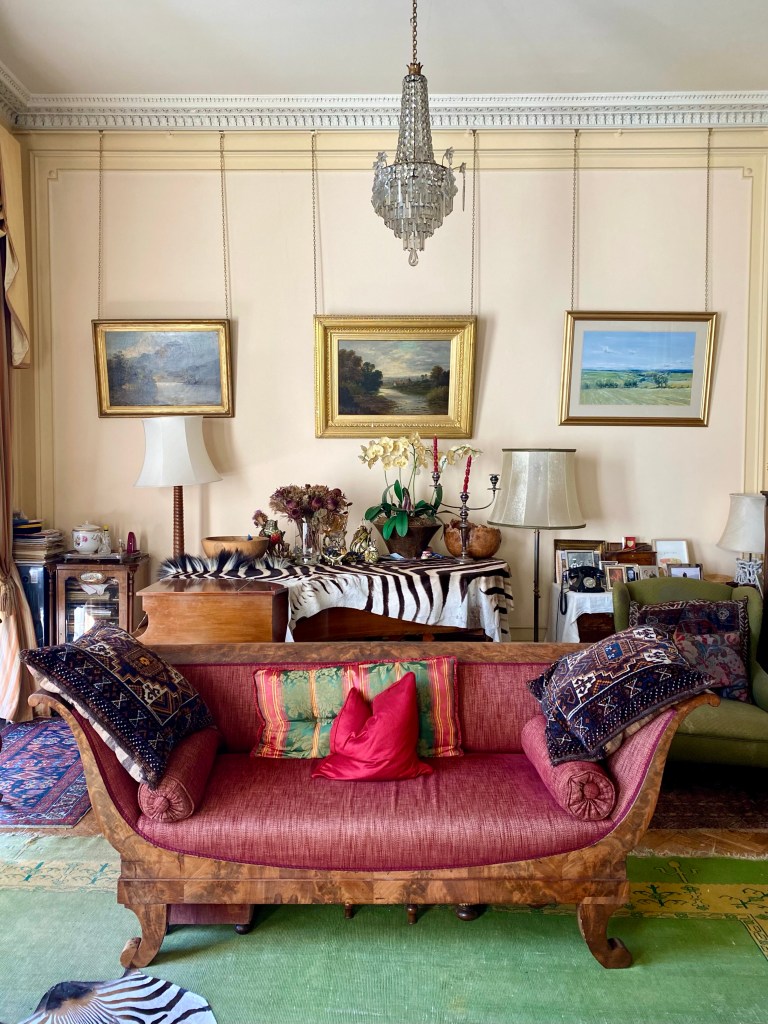
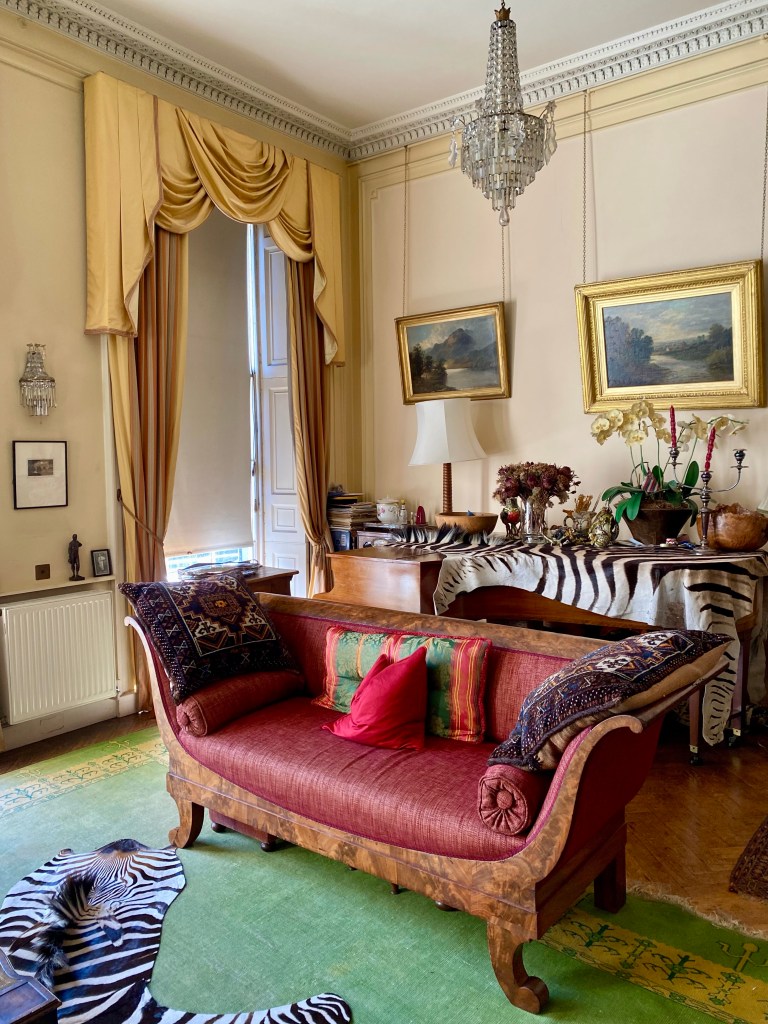
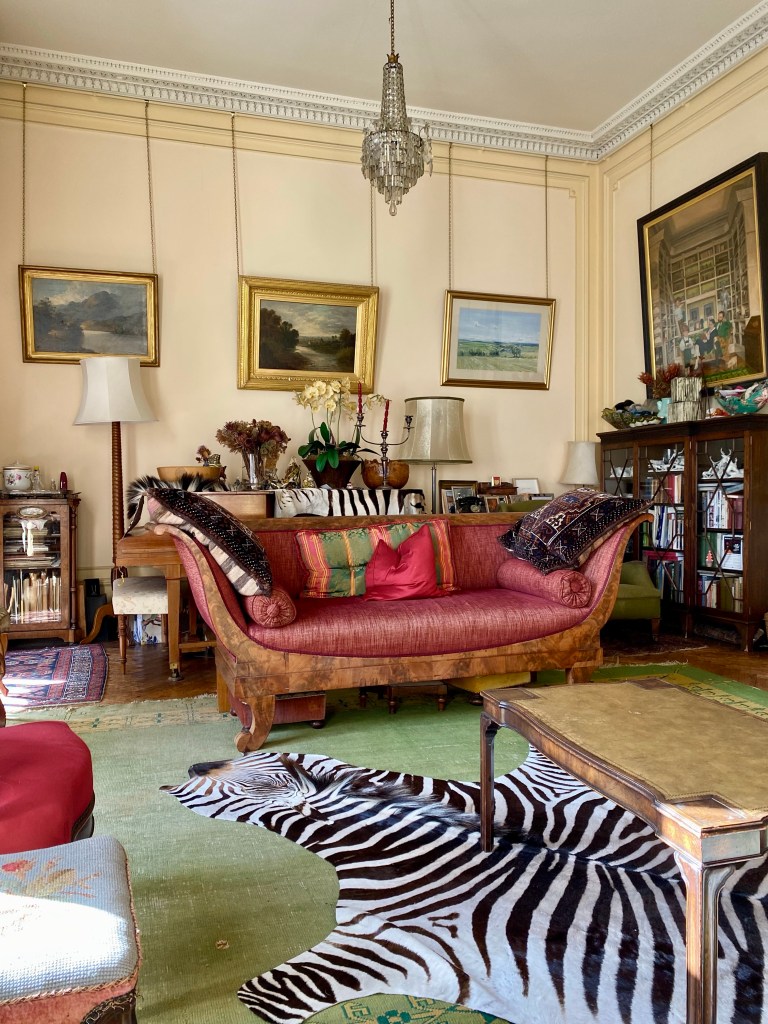
For Fiona and me, the hour and a half went by very quickly. As I mentioned, John is an engaging, knowledgeable speaker, clearly enthusiastic about his subject, and Fiona and I thought he could easily give public talks on RLS if the opportunity ever arose.
Towards the end of our visit, I asked if it would be possible to get a glimpse of some of the other rooms in the house and John kindly showed us one of the bedrooms, the one used by Robert Louis Stevenson’s parents, Thomas and Margaret. Here are some photos I took of that stunning room, which I’d only previously seen on the Stevenson House website. Notice the beautiful William Morris pattern wallpaper and the lovely family pictures. The bedroom also has an impressive four-poster bed.
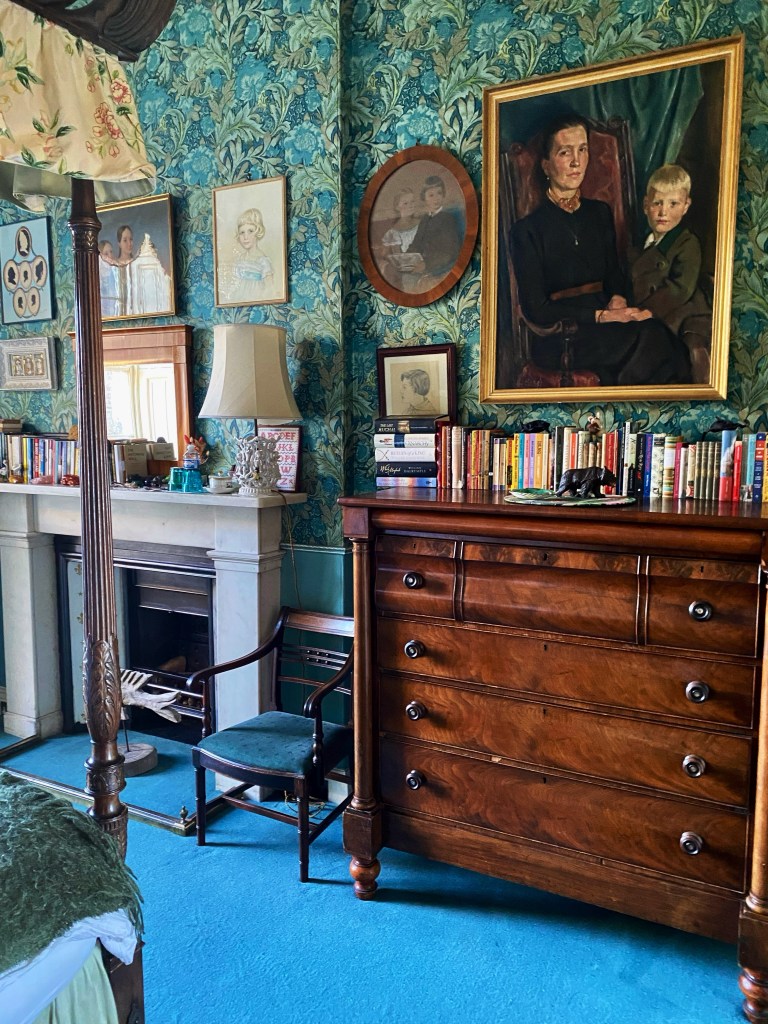
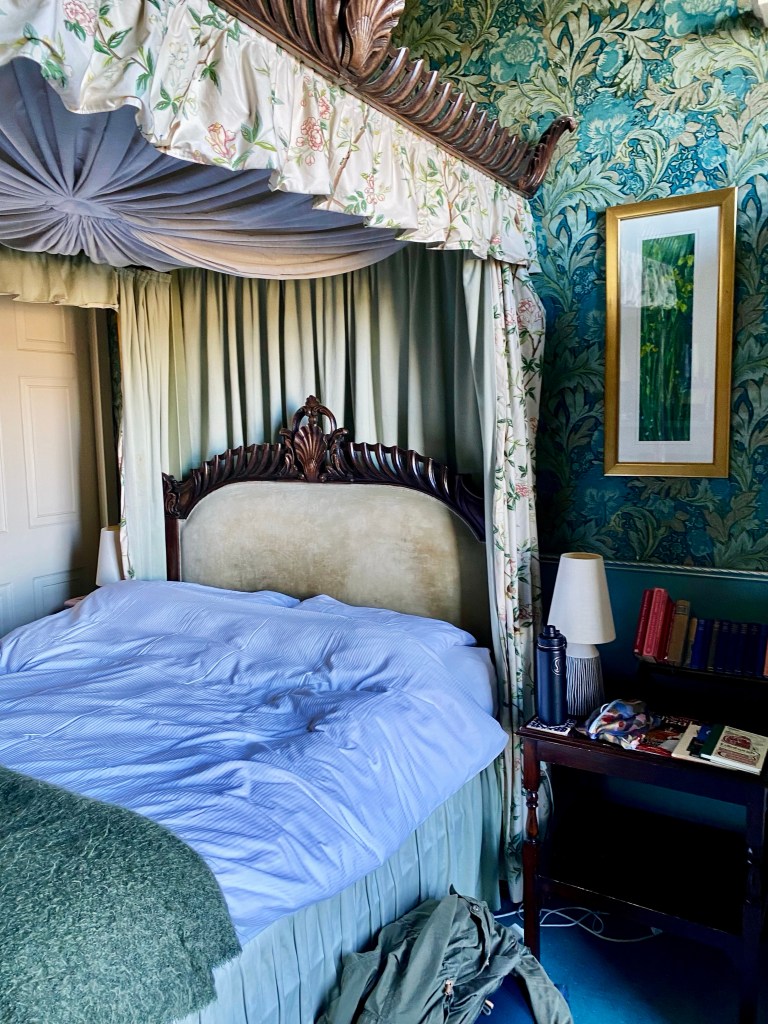
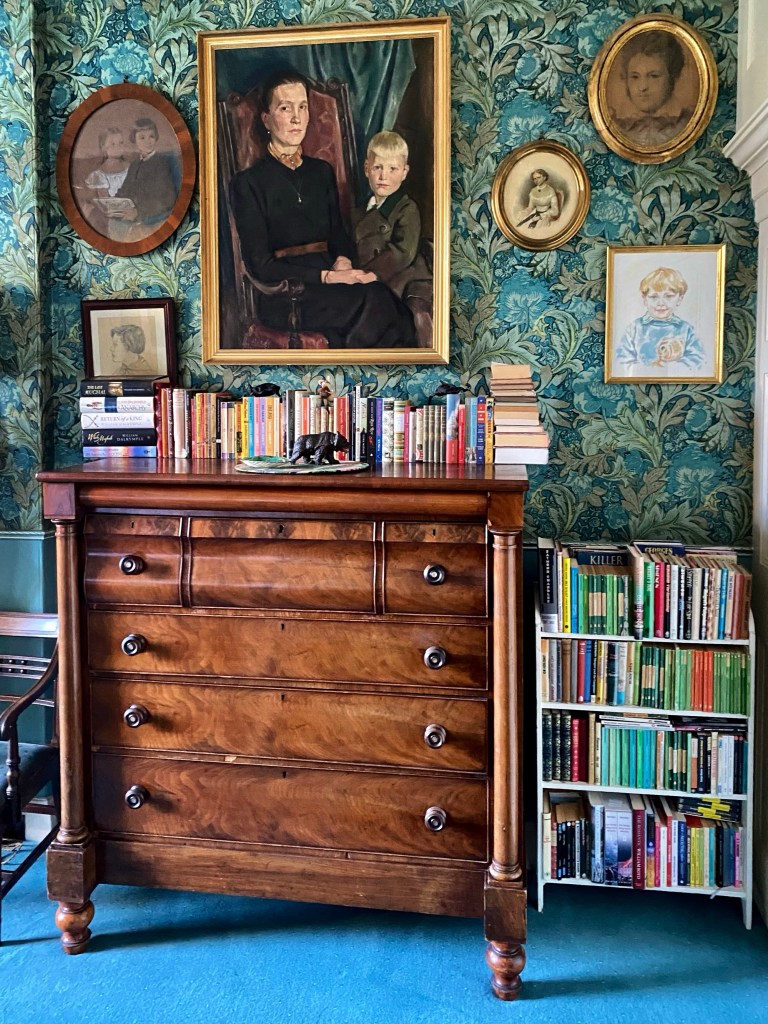
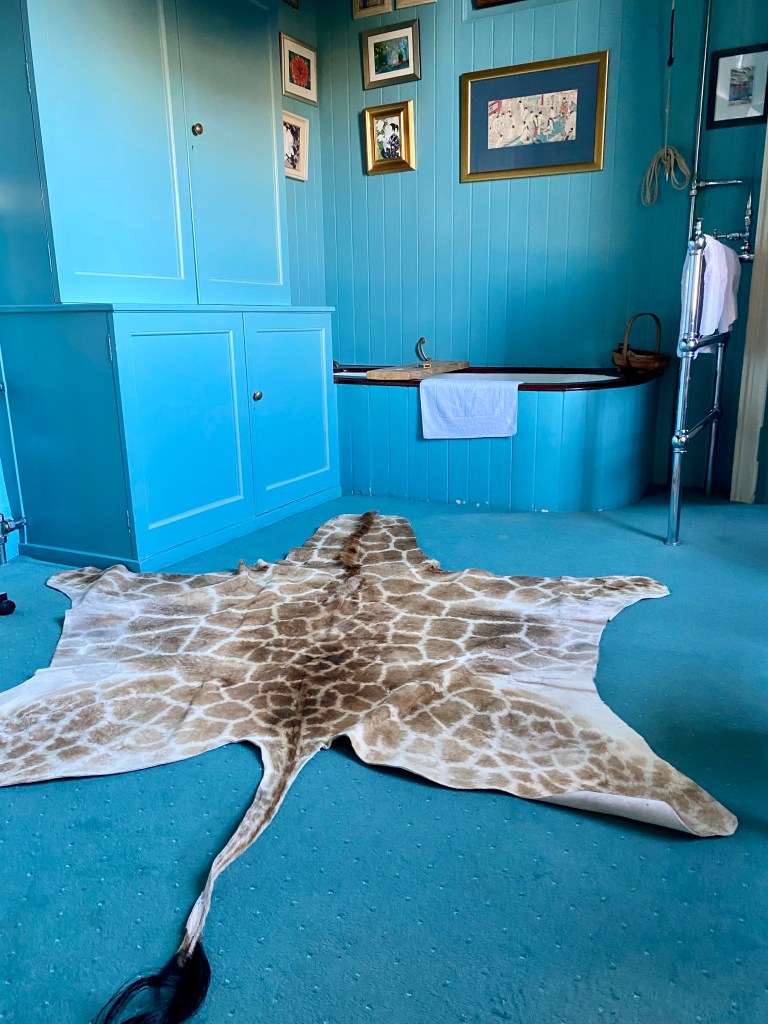
This bedroom is one of two at the Stevenson House that can be stayed in on a bed-and-breakfast basis. I can only imagine it would be a wonderful experience, not only because it’s a gorgeous room and house but also because of the hospitality of the hosts. If you were a lover of Robert Louis Stevenson’s work, then the place would clearly have an added significance but even if you were only looking for a quiet family home in Edinburgh’s New Town, this unique house would be a perfect place to stay.
Next, John led us downstairs to see the dining room. The grand spiral staircase we descended is the one that RLS would ascend late at night as a student, grateful that the steps were made of stone so he could pass his parents’ bedroom without disturbing them. Oddly enough, as I went down them, this was the one moment when I felt the presence of RLS.
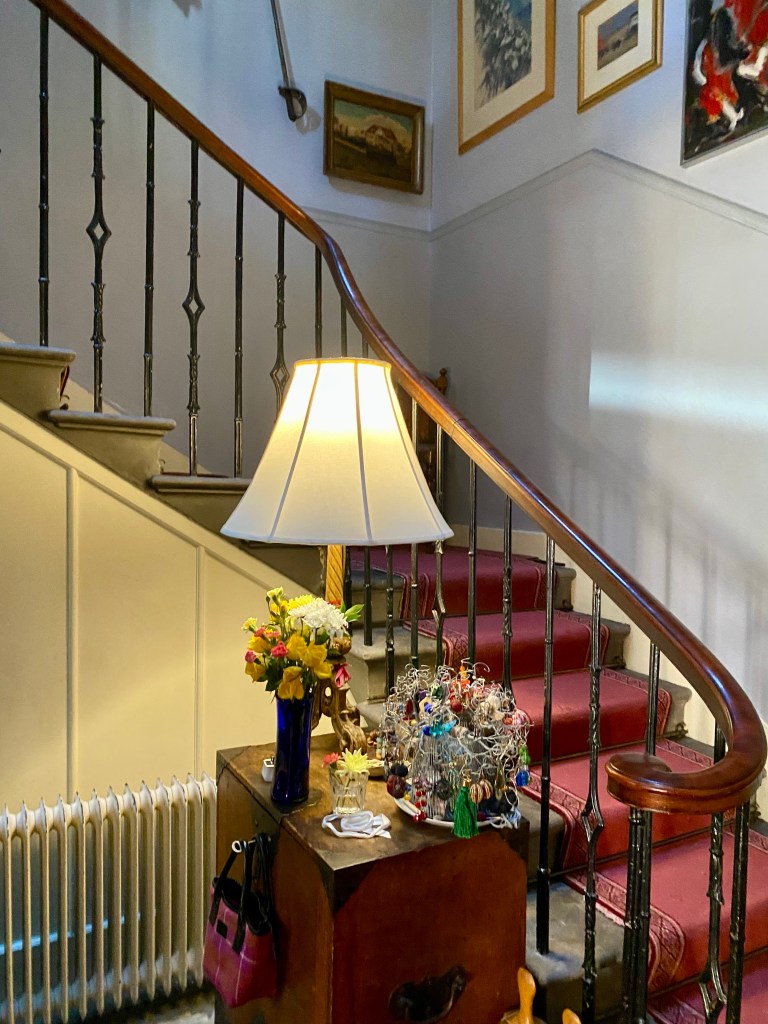
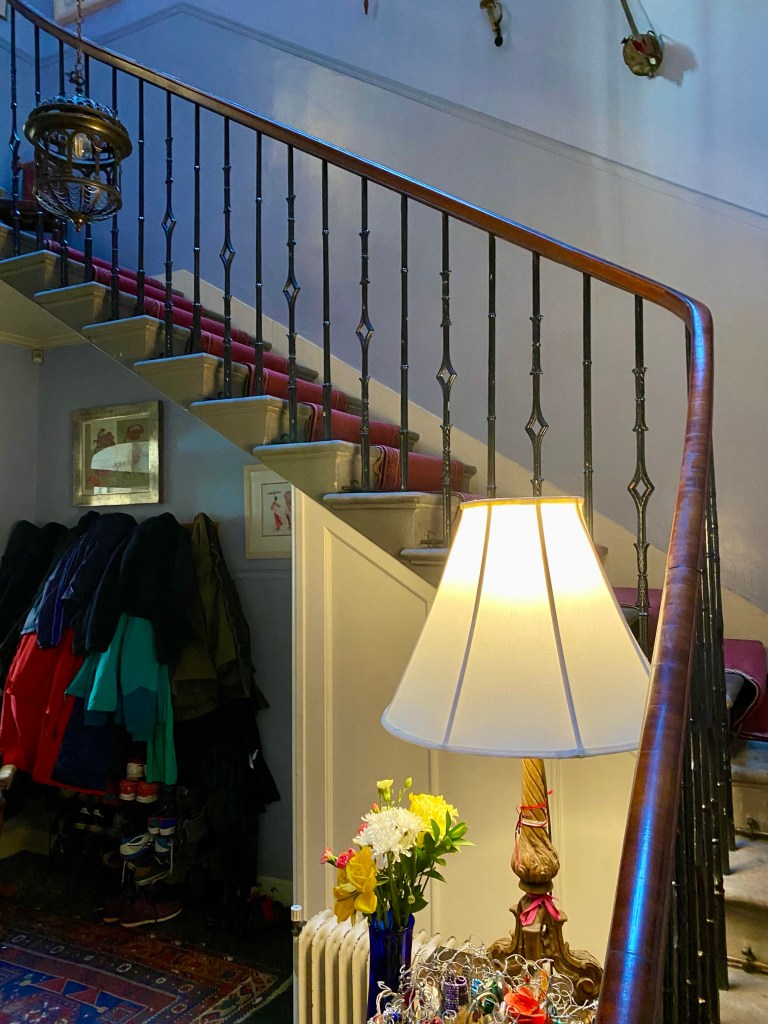
John did mention that the house is haunted – I suggested possibly by Cummy, Robert Louis Stevenson’s nanny, as somehow I can easily imagine her indispensable presence in this house, taking care of the children of successive families – just as she took care of RLS at one time. But there have been many owners of the Stevenson House since Thomas Stevenson bought it in 1857 – I think the number John mentioned was eleven – so, if it’s haunted, it could be by any one of a large number of people.
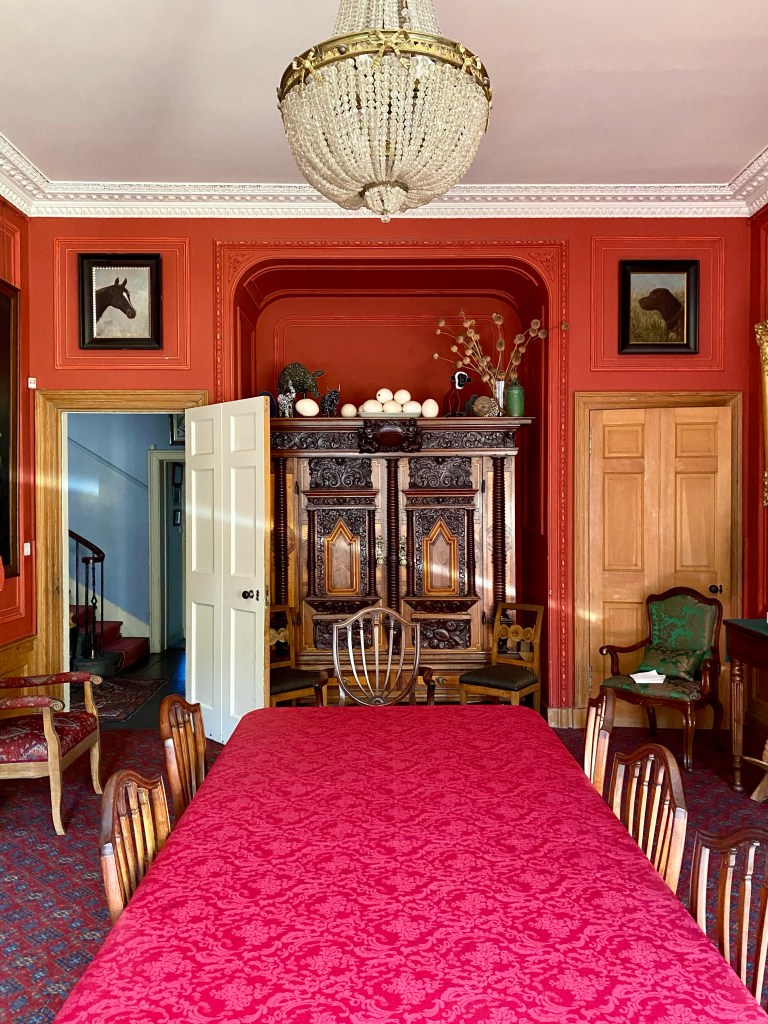
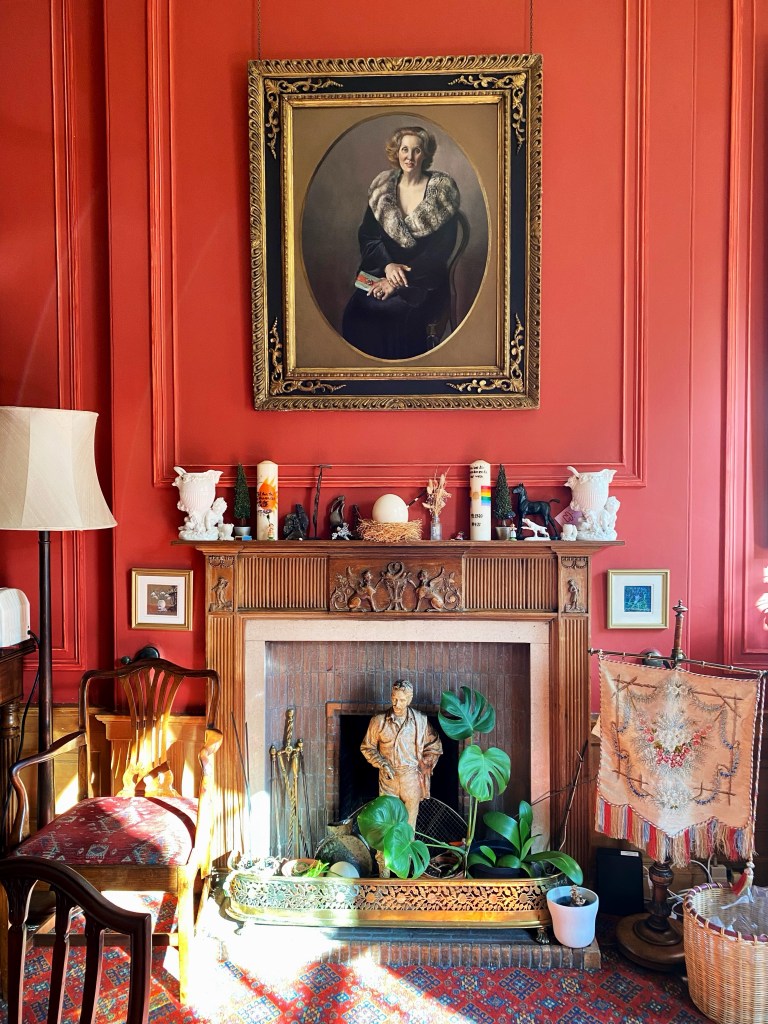
This is the dining room at 17 Heriot Row. Again, it’s a beautiful room, full of interesting pieces of furniture and with many gilt-framed paintings adorning the walls. I wish I’d asked who the subjects were. Perhaps former residents of the house? In this photo, you can see the long dining table with its crimson tablecloth, the lovely chandelier above the table, and a glimpse of that carpeted stone staircase through the doorway.
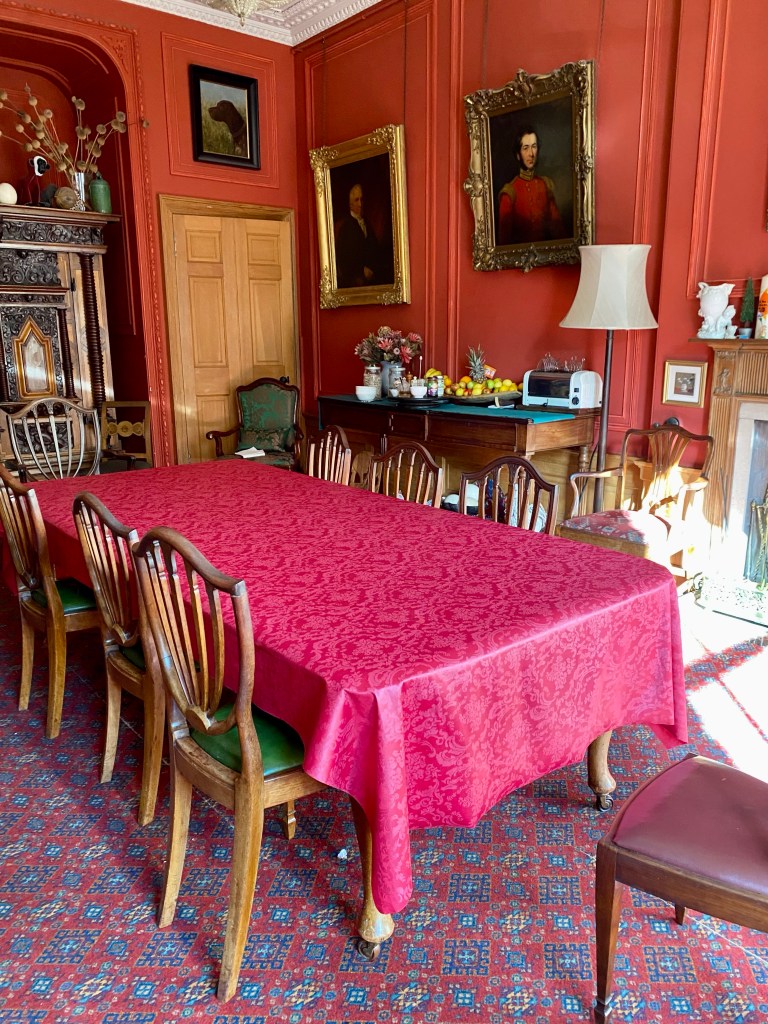
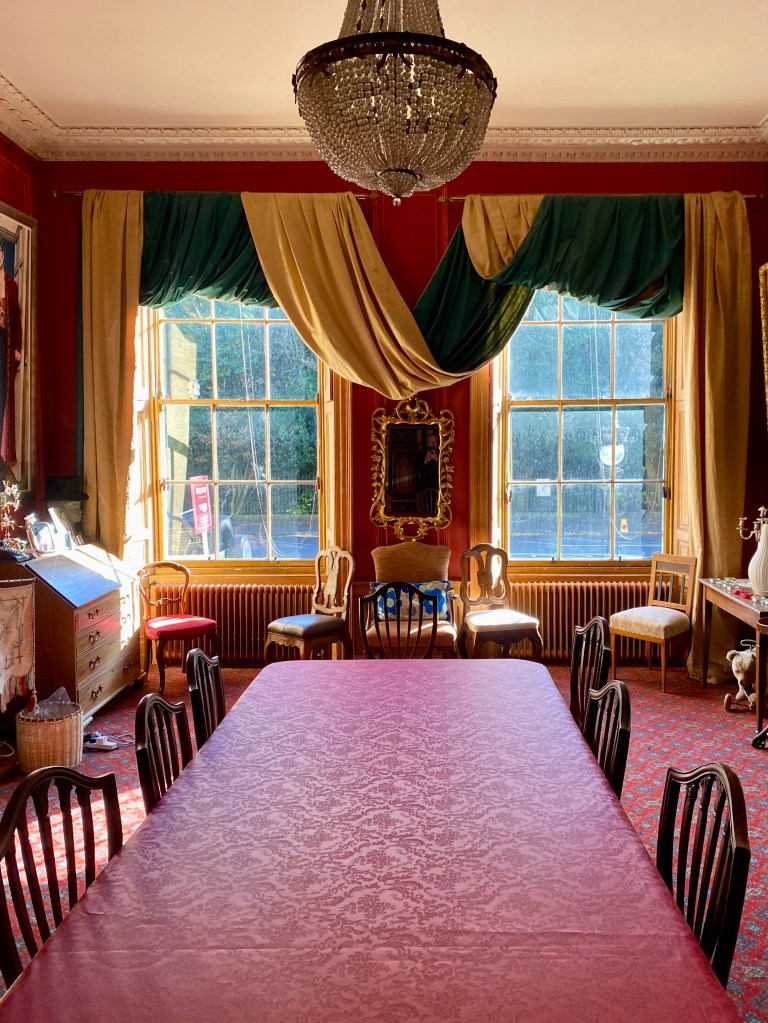
In the following photo, you can see a little statue of Robert Louis Stevenson in the dining room’s fireplace. This was the second statue of him I saw in the house, the first being in the fireplace of the room upstairs, where Fiona and I had sat, chatting with John. I wonder if there were any more in any of the other rooms. Curiously, there’s a similarly small sculpture of the author in a fireplace in the Writers Museum in Edinburgh. RLS always did like warm places!
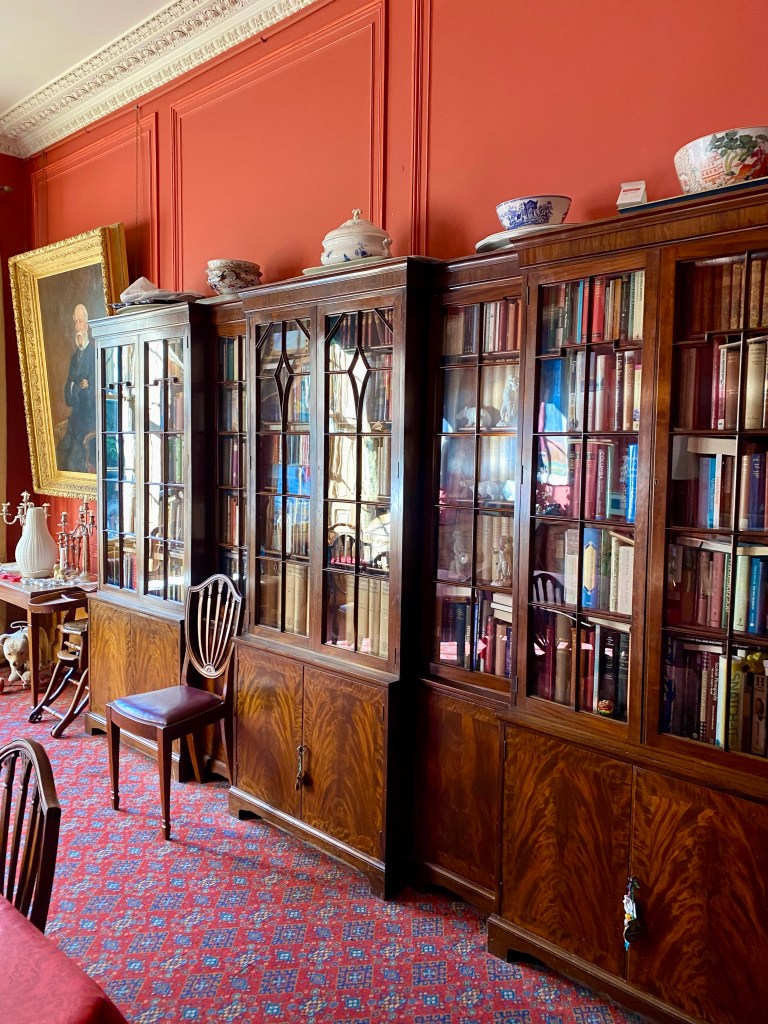
I was delighted to see that there were plenty of books in all of the rooms we saw in the Stevenson House. If ever a house deserved to be full of books, it’s this one. Here are some in the dining room.
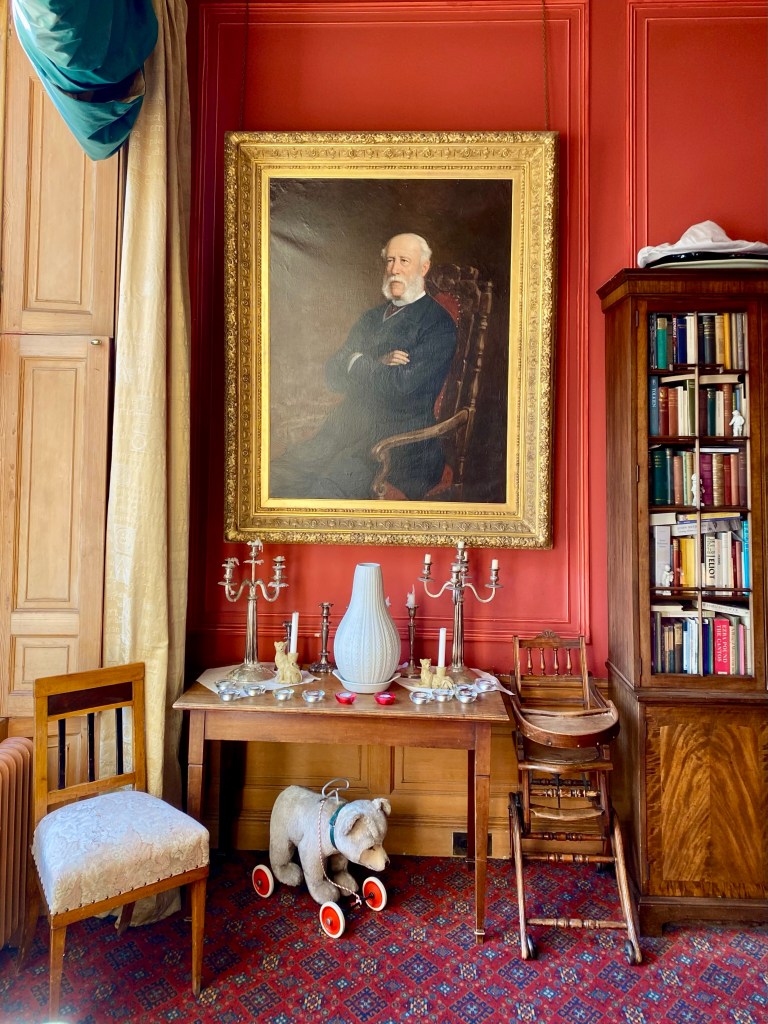
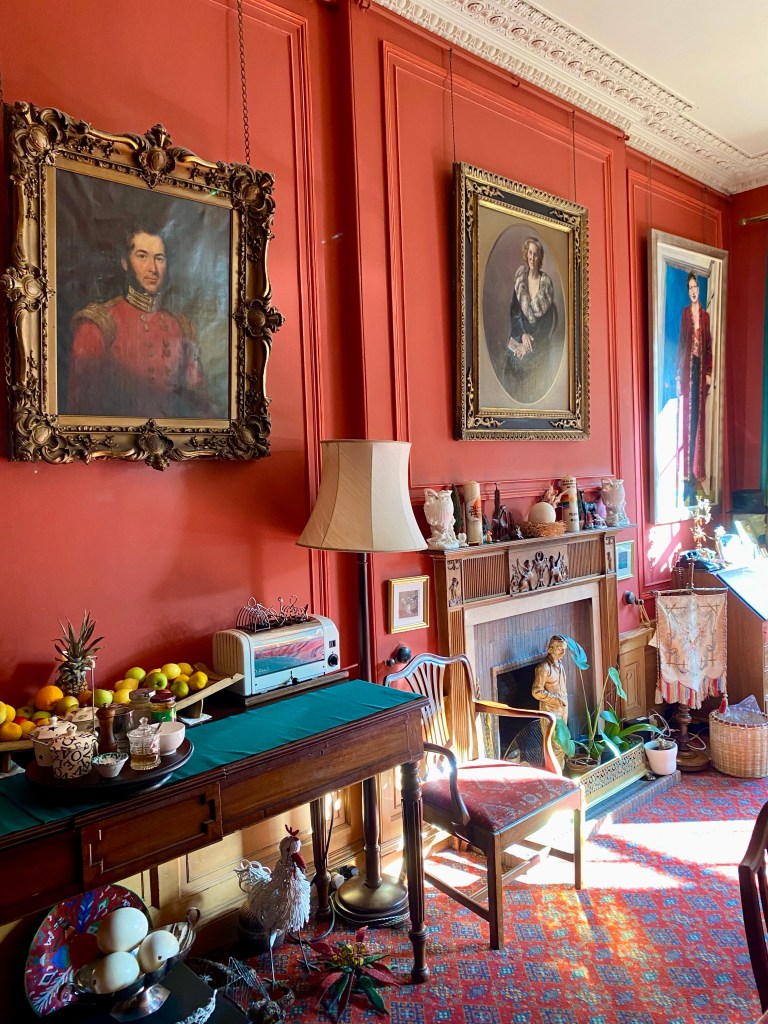
And so it came time to say goodbye and thank John for his great kindness in showing us around the house and for sharing his great knowledge of its most famous residents – Robert Louis Stevenson may be why the house is remembered today but his father, Thomas Stevenson, was also a significant figure in his time, and he was mentioned in our conversation too.
I loved the entire experience – loved chatting to and listening to John, and loved – finally! – getting to look around the home where one of my favourite authors once lived. And, of course, I’m enormously grateful to John Macfie for inviting me to visit his home and for sharing his impressive knowledge of Robert Louis Stevenson with us.
More information about the Stevenson House and what it offers can be found here:
Robert Louis Stevenson in Edinburgh
I love Edinburgh, the capital city of Scotland, for a variety of reasons and one of them is that it’s where Robert Louis Stevenson, one of my favourite writers, was born and grew up.
Luckily, I live close to Edinburgh and can visit as often as I like. Edinburgh is extremely popular with tourists, especially in the summer months and particularly in August when the Edinburgh festivals are on. These are both a blessing and a curse for the people of Edinburgh. The tourist dollars are certainly a welcome source of revenue for local businesses but the sheer number of visitors can present problems for those who live and work in the city. But summertime is when Edinburgh truly comes alive. That’s when the streets are full of entertainers, and when all the varied and wonderful shows at the Fringe take place. That’s when the attractions, such as the Castle and the Holyrood Palace, are teeming with curious visitors from all over the world. It’s not only the various festivals and attractions that draw people to Edinburgh, of course. Perhaps more important is the history of the place. Walking around Edinburgh’s Old Town is an experience few visitors will ever forget. Full of mediaeval streets and Reformation-era buildings, the Old Town has been home to many famous figures such as John Knox, the leader of the Scottish Reformation; Sir Walter Scott, the great historical novelist; and David Hume, the Scottish Enlightenment philosopher.
The Royal Mile in the heart of the Old Town is a remarkable series of streets that run from Edinburgh Castle at the top down to the Palace of Holyroodhouse at the bottom. Both the Castle and the Palace have been homes to Kings and Queens such as Mary, Queen of Scots and King Charles I. Today the Castle is both a tourist attraction and the Regimental Headquarters of the Royal Regiment of Scotland. Holyrood Palace is both a tourist attraction and the official residence of the British monarch in Scotland.
It was in this historic Scottish city that Robert Louis Stevenson, the author of Treasure Island, Kidnapped, and The Strange Case of Dr Jekyll and Mr Hyde, was born on 13th November 1850. Stevenson was born at 8 Howard Place to Thomas and Margaret Isabella Stevenson. Thomas Stevenson was a leading civil engineer who designed over 30 lighthouses in and around Scotland. The couple christened their son Robert Lewis Balfour Stevenson but everyone called him Lewis. When he was around the age of eighteen, RLS changed the spelling of “Lewis” to “Louis”. When he was around twenty-three, he dropped the “Balfour” altogether. As he’s known to the wider world as Robert Louis Stevenson, I’ll use that name or variations on it for the purposes of this post.
In addition to the homes listed in the rest of this post, Robert Louis Stevenson spent many of his boyhood summers at his grandfather’s house in Colinton, a quiet village in the southwest of Edinburgh. Lewis Balfour, his grandfather, was a minister with the Church of Scotland and his Manse had a large garden, which Stevenson loved playing in with his cousins. Sadly, his grandfather died when Stevenson was nine years old. In 1867, Stevenson’s parents leased a large, beautiful cottage in Swanston for summer use and retained the lease for 14 years. This cottage became as important to Stevenson as his grandfather’s Manse had been in earlier years.
 The Literary Tourist